The University of Hong Kong Museum Society is pleased to present an exclusive tour to two of today’s most dynamic regions of contemporary art and architecture: the Arab Gulf states of Qatar and the United Arab Emirates, and the South Caucasus nation of Azerbaijan. This survey tour will be held in conjunction with programs specially arranged for our group at Art Dubai 2014.
Both the Arab Gulf states and Azerbaijan comprise of wealthy governing patrons who have conscientiously invested into growing the contemporary art scene in addition to having invited some of the world’s most renowned architects and designers to build an environment of amazing structures. In a seven day period, our group will meet key players in Doha, Sharjah, Abu Dhabi and Dubai, including private art collectors, scholars, curators and artists, as well as see first rate art, architecture and design. We will be visiting the homes of private collectors as well as the regions’ highly acclaimed museums.
Similarly our four day visit to Azerbaijan, aptly labeled the Dubai of the Caucasus will consists of private visits to homes of local collectors and artist studios in addition to enjoying an overview of world architectural masterpiece structures within Baku. We will make time to visit the UNESCO World Heritage sites of the old walled city of Baku with the Shirvanshah’s Palace and Maiden Tower as well as tour the oil fields outside of the city.
Our tour will correspond with Art Dubai, the leading international art fair in MENASA (Middle East, North African and South Asia), which over the past seven years has become a cornerstone of a booming, contemporary art community. In 2013, Art Dubai presented 75 specially selected galleries from 30 countries.

The famous Chinese proverb 「民以食為天」 can be loosely translated as “food is heaven” or “food is people’s #1 need” – revealing the high regard Chinese people place on food. Bearing this in mind, it is not difficult to understand why there is so much emphasis on the importance of 「色、香、味、形」, or ‘colour, aroma, taste, and presentation’.
Guangdong Province (廣東省) amongst all the provinces is most prominent for its cuisine, and Zhongshan (中山), a prefecture of Guangdong, tops the list for its creativity and ingenuity in its culinary fanfare. Located along the western side of the Pearl River Estuary (珠江三角洲), Zhongshan lies south of Guangzhou (廣州), and north of Zhuhai (珠海) and Macao (澳門). Blessed with fertile fields and mulberry fishponds that bring abundant fresh ingredients to its dishes, Zhongshan is a breeding ground for the unique regional cuisine that has enriched the country’s epicurean culture.
In this 2 nights and 3 days culinary journey, we will taste a variety of exciting and interesting recipes that are probably less well-known – juice from water crabs tasted through a straw; delicate chicken fed on sunflower seeds; crispy and crunchy mouths of the big fresh water fish; collagen-like sea turtle stewed in royal recipe, plus many more.
Our resource person for this trip is May Fung, acclaimed host of the culinary show “May 姐有請” (“Cook Away Lady May”), the highly rated TVB Jade program now into its second season. After retirement as Artist Manager of TVB and Executive Director of Programming at Cable TV, May challenged herself to a second career in the culinary field. Her interest and passion for food motivated her to write cookbooks containing simple, easy and tasty recipes. She will take us on a journey to explore Zhongshan’s fresh produces through its diverse array of delicious delights.
The trip is now full. We are grateful to members for their enthusiastic participation which gives our committee a greater incentive to plan for more exciting trips in the future. Thank you!
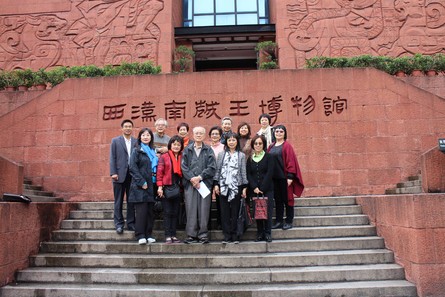
I. Chinese Ceramic Pillows Exhibition at the Museum of the Western Han Dynasty Mausoleum of the Nan Yue King with Curator Wu Lingyun (吳凌雲), and “Pillow Talk” with Professor Mai Yinghao (麥英豪教授).
II. Chinese Export Fine Art in the Qing Dynasty Exhibition at the Guangdong Museum with Curator Dr. Lily Bai Fang (白芳博士)
Itinerary
After arriving at Guangzhou East Station, our private coach will take us to the Museum of the Western Han Dynasty Mausoleum of the Nan Yue King. We shall be guided by Curator Wu Lingyun to view the world-renowned collection of Chinese ceramic pillows, many of which were donated by Hong Kong collector Mr. & Mrs. Yeung Wing Tak. Archaeology Professor Mai Yinghao will give a talk on the history, forms, materials, techniques, functions, inscriptions and symbolisms of various dynasties to enhance our understanding and appreciation of this special Chinese art form.
As Guangzhou is famous for its cuisine, we will lunch at a local restaurant to savour their regional specialties.
After lunch, we will visit Guangdong Museum and see their current exhibition Chinese Export Fine Art in the Qing Dynasty. Curator Dr. Lily Bai Fang will guide us through the exhibits of paintings, ceramics, fans, embroideries, business card boxes, as well as artworks in ivory, silver, lacquer and combination materials. The trip concludes when our private coach takes us back to East Station for the through-train back to Hong Kong.
Resource Persons
Wu Lingyu is Curator at the Museum of Western Han Dynasty Mausoleum of Nan Yue King. Professor Mai Yinghao is Consultant for the Museum of Western Han Dynasty Mausoleum of Nan Yue King; Guangzhou Museum Director; Advisor of the Chinese University of Hong Kong Art Museum; and renowned archaeologist who had led several major national excavations. Dr. Lily Bai Fang holds a doctorate degree in History, as well as a fellowship at Peabody Essex Museum. She is now Assistant Director in Guangdong Museum, responsible for acquiring and researching on China Trade collection.

Geoffrey Longfellow –
"We welcome our friends from Hong Kong to Thailand, and hope that you will have an exciting and informative trip. Most visitors know of our country's wonderful beaches, food, and hospitality, but we will attempt to give you an inside look at the unique history and culture that differentiates Thailand from its neighbours. Thailand's capital, Bangkok, is a vibrant international city, but you will also get a glimpse of rural life, and the way in which most Thai people have lived for generations. You will have the opportunity to meet people of various backgrounds, and have the chance to explore some special places unknown to most visitors."
Through the kind introduction of our member Arunee Chan, the host for this trip will be Geoffrey Longfellow, an adviser on foreign affairs to the Queen of Thailand and a volunteer to Her Majesty's SUPPORT Foundation. A graduate of The Johns Hopkins University, he is adjunct professor at Chulalongkorn and Thammasat Universities. He has acted as Country Representative for organizations like Sotheby's, Galileo Asset Management, and Cap Gemini Consulting. Being a dual Thai-American national, he speaks fluent Thai and has been active in the educational, financial, social, and community work in Thailand since 1977.
Highlights of Bangkok to Chiang Mai
• Central Anniversary Flower Extravaganza, local colour stone jewelry
• Temple of the Emerald Buddha and the Grand Palace, visit the inner court and state apartments as guests of The Bureau of the Royal Household
• Tour of Queen Sirikit's Textile Museum with the Museum Director
• Vimanmek Palace and gardens, Throne Hall, and view works from Queen Sirikit's SUPPORT Foundation
• Tour of Vordis Palace private residence with its present owner
• Bang-Pa-In Summer Palace and gardens
• Old capital Ayudhaya
• Buddhist complexes in Chiang Mai, Doi Suthep mountain monastery
• Tour of Bhuping Palace and gardens with the Palace Director
• Temples of Wat Pra Singh and Chedi Luang
• Mae Rim and Samoeng districts, elephant ride, Hill Tribe Village
• Private home/artist studio visit, morning walk by the river with monks receiving alms from the faithful, night bazaar, souvenir shopping
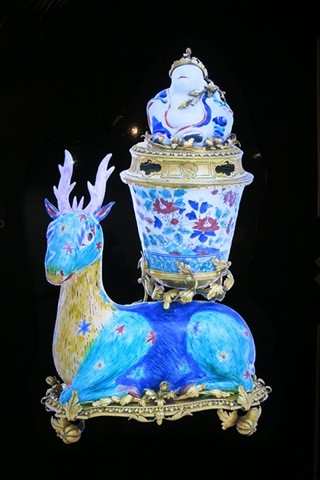
Our day of 'Le French May in Macau' begins with a morning visit guided by UMAG Director, Dr. Florian Knothe, to the exhibition Fantasy World – Chinoiserie at the Macao Museum. French Chinoiserie is a hybrid style incorporating Chinese motifs and patterns into French design. French as well as rare imported Chinese artefacts – some transformed by French artisans into more Western utilitarian and display objects – enriched royal interiors, particularly those of the court of Louis XV during the Rococo period (1725-1750). We will retrace the history of the French taste for Chinoiserie, and the strong bonds between China and France during the 17th and 18th centuries.
After a morning's viewing, we will enjoy lunch at the three-Michelin-starred restaurant Robuchon au Dome, formerly Robuchon a Galera. Located at the dome of the Grand Lisboa Hotel, it offers stunning views of Macau. The chef will create a seasonal 3-course menu showcasing the culinary artistry that has earned the restaurant many accolades.
In the afternoon, we will visit Macao Museum of Art to see the exceptional exhibition, Napoleon and the Decorative Arts: Treasures of the Imperial Palaces. Shown for the first time, this exhibition comprises a unique collection of Empire-style furniture and decorative arts that are symbolic of the legendary Napoleon I Bonaparte, Emperor of France from 1804 to 1815, and early 19th century elegance and interior decoration. Many of the finest pieces of furniture, tapestries, candelabras, chandeliers and pendulum clocks from Napoleonic palaces, display the grand and opulent style of the Empereur des Francais which appropriated emblems of power from the ancient Greek, Roman and Egyptian cultures.
Resource Person
Dr. Florian Knothe completed his doctoral research on the social and historic importance of royal French manufacture, and has studied and taught the history of decorative arts in the 17th and 18th centuries. He has long been interested in the early modern fascination with Chinoiserie and the way royal workshops and smaller private enterprises helped to create and cater to this long-lasting fashion.
Dr. Knothe started his career at The Metropolitan Museum of Art focusing on European Sculpture and Decorative Arts. Before joining The University of Hong Kong, where he now serves as Director of the University Museum and Art Gallery, Dr. Knothe was the curator of European glass at The Corning Museum of Glass overseeing the European and East Asian departments. There, he organized an exhibition on East Meets West, and afterward, lectured internationally on cross-cultural influences in art and workshop practices in Western Europe and East Asia.

Visitors to museums in Luoyang and Xi'an often come across Tang dynasty figurines with deep set eyes, pointed noses, thick eyebrows and beards, wearing turbans riding on camels. This is the realistic portrayal of Sogdian caravan traders who trekked the Silk Road in between China and Central Asia in the 5th and 6th centuries. Many of them settled in China and some even served in the Tang court, the infamous general and rebel An Lu Shan being one of them. They came from Sogdiana, a strip of fertile land lying in between Amu Darya and Syr Darya, sandwiched by lofty mountains and deadly deserts.
It was also from here that the ambitious Tamerlane set out to build a huge 12th century empire which covered present day Central Asia, the Balkans as well as Iran and Afghanistan. Apart from being a conqueror, he was also a patron of the arts and many of his legacies can still be seen today. The excursion will bring us to Samarkand and Bukhara, the gems of ancient Sogdiana, as well as to Khiva, one of the best preserved ancient caravan cities in Central Asia, to explore the history and culture of the place through visits to impressive mosques, mausoleums, madrassahs, bazaars and museums.
Resource Person
We are privileged to have as our guest lecturer, Dr. Joseph Ting. He majored in Chinese Literature and Chinese History from HKU and graduated with a BA degree in 1974. He was conferred an MPhil in 1979 and a PhD in 1989, also from HKU.
Dr. Ting joined the HK Museum of Art as an Assistant Curator in 1979 and was appointed Chief Curator of the HK Museum of History in 1995. He retired in 2007 after serving for 28 years. He is currently an Honorary Assistant Professor in the School of Chinese at The University of Hong Kong, as well as an Adjunct Professor in the Department of History at the Chinese University of Hong Kong.
He is Honorary Advisor to many art and cultural institutions, including the HK Museum of Art, the HK Museum of History, HKU Museum and Art Gallery, the Shenzhen Museum and Guangdong Provincial Museum. He is also a Member of the Antiquities Advisory Board, the Lord Wilson Heritage Trust and the Education Bureau of Hong Kong; an Honorary Fellow of the HKU and Hong Kong Institute of Education; and an Honorary Research Fellow at the former Centre of Asian Studies.
Visitors to museums in Luoyang and Xi'an often come across Tang dynasty figurines with deep set eyes, pointed noses, thick eyebrows and beards, wearing turbans riding on camels. This is the realistic portrayal of Sogdian caravan traders who trekked the Silk Road in between China and Central Asia in the 5th and 6th centuries. Many of them settled in China and some even served in the Tang court, the infamous general and rebel An Lu Shan being one of them. They came from Sogdiana, a strip of fertile land lying in between Amu Darya and Syr Darya, sandwiched by lofty mountains and deadly deserts.
It was also from here that the ambitious Tamerlane set out to build a huge 12th century empire which covered present day Central Asia, the Balkans as well as Iran and Afghanistan. Apart from being a conqueror, he was also a patron of the arts and many of his legacies can still be seen today. The excursion will bring us to Samarkand and Bukhara, the gems of ancient Sogdiana, as well as to Khiva, one of the best preserved ancient caravan cities in Central Asia, to explore the history and culture of the place through visits to impressive mosques, mausoleums, madrassahs, bazaars and museums.
Resource Person
We are privileged to have as our guest lecturer, Dr. Joseph Ting. He majored in Chinese Literature and Chinese History from HKU and graduated with a BA degree in 1974. He was conferred an MPhil in 1979 and a PhD in 1989, also from HKU.
Dr. Ting joined the HK Museum of Art as an Assistant Curator in 1979 and was appointed Chief Curator of the HK Museum of History in 1995. He retired in 2007 after serving for 28 years. He is currently an Honorary Assistant Professor in the School of Chinese at The University of Hong Kong, as well as an Adjunct Professor in the Department of History at the Chinese University of Hong Kong.
He is Honorary Advisor to many art and cultural institutions, including the HK Museum of Art, the HK Museum of History, HKU Museum and Art Gallery, the Shenzhen Museum and Guangdong Provincial Museum. He is also a Member of the Antiquities Advisory Board, the Lord Wilson Heritage Trust and the Education Bureau of Hong Kong; an Honorary Fellow of the HKU and Hong Kong Institute of Education; and an Honorary Research Fellow at the former Centre of Asian Studies.

Known as the Land of the Thunder Dragon, Bhutan is one of the most mysterious and unknown of all Himalayan Kingdoms, comfortably hidden in isolation behind the high peaks of the Himalayas. A trip to Bhutan is like having a magic wand transporting one back to the 15th century. Forbidden to foreigners for centuries, this timeless Buddhist Kingdom has succeeded in preserving its enchanting traditions and ancestral way of life. This is further epitomized by the state's mandate of Gross National Happiness, whereby economic development, a goal for much of its humanity, is only a means to the real goal of happiness.
This trip combines the best of what Bhutan offers with a good mix of both cultural and active pursuits! We begin our tour in Thimphu, the only capital in the world without any traffic light! We shall catch the weekend market, visit the National Textile Museum, Folk Heritage Museum, National Institute of Arts and Crafts and more, before taking a winding scenic mountain route to Punakha. After touring the impressive Punakha Dzong, we can enjoy either day hikes in the cultivated valley of Punakha, or take an excursion to the nearby Phobjikha Valley. We then re-cross Dochu La Pass to Paro and explore the beautiful valley of Paro, ending with a visit to the dramatic Taktshang Monastery, built on a sheer cliff face at a height of 2950m above sea level.
The trip is now full. We are grateful to members for their enthusiastic participation which gives our committee a greater incentive to plan for more exciting trips in the future. Thank you!

Aichi Prefecture (愛知縣), known internationally as the venue for 2005 Aichi World Expo, is located in the center of Japan, and historically a corridor between the east, west, north and south. Nagoya (名古屋), the capital of Aichi, is becoming an increasingly frequented city which has much to offer visitors. It is surrounded by the rich natural sceneries of the sea and green mountains, as well as many heritage sites and cultural treasures.
Aichi is the base for many important industries ranging from traditional textiles and ceramics, to aerospace and automobiles. It is also home to headquarter of Toyota Motors. Culturally, it hosts the Aichi Art Triennale with exhibitions of contemporary art, along with theatre, music and dance performances from all over the world, together with training workshops.
The dichotomy of the historical and traditional establishments versus modern and technological developments make Aichi Prefecture one of the most fascinating areas in Japan. According to a recent Times Magazine's Global Adviser, "If Kyoto is Japan's most alluring cultural fact and Tokyo its most vibrant and modern expression, then Nagoya, the country's third largest city and a port, would be Japan seen through a rain-spattered window."
HKUMS proudly organizes this spring 2013 tour to experience the best of the slightly late bloomer Nagoya and its vicinities in Aichi Prefecture, which is packed with a rich past history, present glory, and natural beauty.
The trip is now full. We are grateful to members for their enthusiastic participation which gives our committee a greater incentive to plan for more exciting trips in the future. Thank you!
Overview:
Since 2011, we began our year with an outdoor visit to see the beauty of nature with Professor Chan Lungsang. As 2013 is our special silver anniversary, instead of a day trip, we shall take a weekend trip to our neighbouring city of Shenzhen.
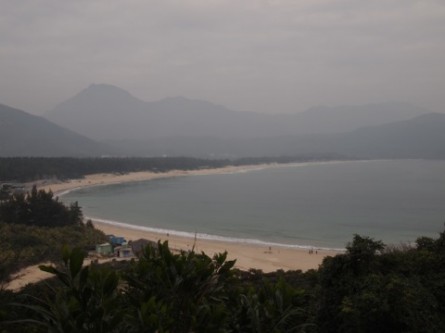
Many think of Shenzhen as a modern bustling city, but a closer examination of her rocks reveals an ancient land. The trip will visit picturesque localities on the eastern side of Mirs Bay. Stops include Xia Sha (下沙), a mile-long beach on the Dapeng Peninsula, and Xiqong (西沖等地) at the southernmost tip of the Peninsula. If time permits, a fossil collection stop will be arranged. The evening’s accommodation will be in a hotel in Nanao. (Day 1 – Lunch and dinner will be provided.)
The next day, we will visit the recently established Dapeng Geopark (大鵬地貭公園) and the Paleontological Museum. If weather permits, a boat cruise will be made in the afternoon to view the coastal landscape of Dapeng Geopark. Their management will kindly make special arrangement for us to enter the park and visit some of its sights. We expect to return to Hong Kong by 6 pm, under normal traffic conditions! (Day 2 – Breakfast and lunch will be provided.)
Resource Person:
Professor Chan Lung-sang (陳龍生教授) is an expert in Hong Kong geology. He received his bachelor degree from Chinese University of Hong Kong and his PhD from University of California at Berkeley. He taught for 10 years in the University of Wisconsin-Eau Claire and 18 years in the Science Faculty of the University of Hong Kong. His leadership in teaching and learning was recognized when he was awarded the University of Hong Kong’s Distinguished Teaching Award in 2009. A true believer of experiential learning, he has led many field trips around Hong Kong for the public and education sectors. He was invited to guest host the TV documentary series Vanishing Glacier in 2008 and Water of Life recently.