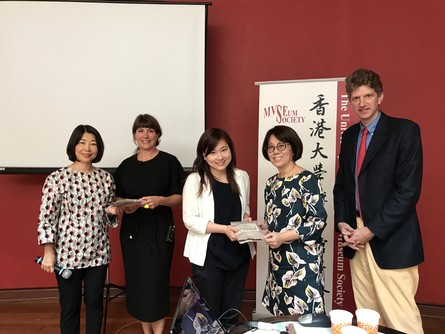
Joint UMAG Programme – A morning at the opera with Dr. Giorgio Biancorosso

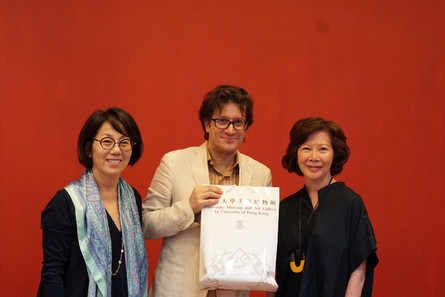
The second of the four "music dramas" that make up the Ring of the Nibelung, Die Walkure weaves utterly compelling music around the haunting story of the Valkyries. As in the Norse sagas on which Wagner drew for his text, in the Ring the Valkyries are "angels of life and death." Their intervention in the life of the all-too-human heroes of Wagner's epic is shocking and all-encompassing. But their main claim to glory lies in their role in the life of the cycle's central character, and subject of its third segment: Siegfried. In this lecture, Biancorosso will introduce to the audience to the difference between "music drama" and "standard" opera and retell the endless fascinating story of how Die Walkure got written.
Opera lovers and Wagner Fans are most welcome!

Resource Person:
Dr. Giorgio Biancorosso Associate Professor in Music, and the Director of the Society of fellows in the Arts and Humanities, The University of Hong Kong. Biancorosso studied music and film studies at the University of Rome and King's College London, before moving to Princeton University, where he obtained a Ph.D. in musicology in 2002.
He is the author of Situated Listening: The Sound of Absorption in Classical Cinema (Oxford University Press. 2016) as well as a number of studies on film music and opera. Biancorosso is also active in Hong Kong as a music programmer and curator.

Heritage Visit- Wanchai Ghostbusting Exploration Tour with Dr. Lee Ho Yin 灣仔捉鬼敢死文物探險團 – 與李浩然 博士

Ghostbusting Guide 捉鬼敢死導賞團長:
The Fearless Dr. Lee Ho Yin, former army sergeant and Head of the HKU Division of Architectural Conservation Programmes (ACP)
「正氣」李浩然 博士
香港大學 建築保育學部 主任
前陸軍軍曹

Description 簡介:
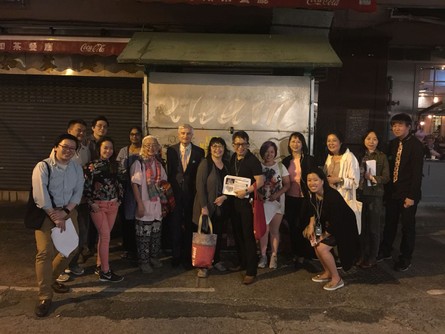
Not for the faint-hearted – join at your own peril! This guided tour takes you – at night – to the old areas of the Wanchai district to explore various reputedly haunted grounds. Through the tour, you will discover the circumstances behind the terrifying stories and urban legends, from which you will learn more about the history and heritage of Wanchai. Please bring your own torch and amulet.

奉學會喻,非胆生毛者請勿參加此行,否則後果自負。此行將帶你夜闖灣仔舊區的多處恐怖迷離境界,識破毛骨悚然的傳聞,發掘故事背後的真相,從而認識多些關於灣仔的史蹟。參與者敬請自備手電筒與護身符。

Language 講述語言:
Cantonese, with English for non-Cantonese speakers if necessary. 人言鬼話,雙語齊下。

Heritage Visit to HK Wetland Park with Professor Raymond Fung

We are privileged to organise a guided tour of the Hong Kong Wetland Park with renowned architect and ink painter Professor Raymond Fung. The HK Wetland Park was originally intended to be an ecological mitigation area. It was developed into the HK Wetland Park, a world-class facility for conservation, education and tourism and features some of the city’s unique flora and fauna. It has received many awards for its architectural and landscape design. Themed exhibition galleries showcase the importance of wetlands on biodiversity, civilisation and conservation. The specially designed habitats are home to an impressive cast of wildlife, including birds, butterflies, dragonflies, amphibians, reptiles and fish.

Resource Person
Professor Raymond Fung (JP, FHKIA) was the main designer of the HK Wetland Park. As a renowned architect, designer and ink painter, he has won the Hong Kong 10 Outstanding Young Person’s Award and the Hong Kong 10 Outstanding Designer’s Award. He has also won 5 HKIA Annual Awards plus over 50 major design and arts prizes locally and abroad. In Ink Art, Fung’s works have been selected in the National Art Exhibition and HK Art Biennale, and largely collected by museums and international corporations. In 2009, he was awarded the Secretary for Home Affairs’ Certificate of Commendation for Art Promotion. Professor Fung is now the Adjunct Professor of the School of Architecture, Chinese University of Hong Kong and committee members to many advisory panels in HK. Apart from his book “The Art of Raymond Fung”, he is also a co-author of five books on architecture and culture.

Weaving Workshop on Ikat Technique With Wing-sum Tsui

Ikat is an ancient resist-dyeing technique named after a Malay root meaning to tie or to bind. It has been practised for centuries in many parts of the world, but reached its most expressive form in the Indonesian archipelago, where it is as widely differentiated as the languages spoken.

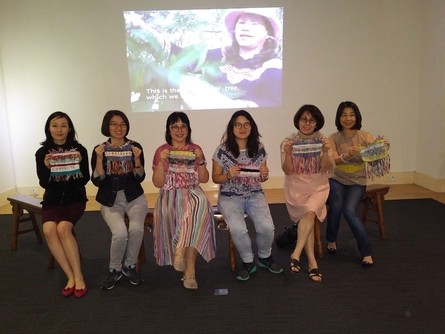
To coincide with the exhibition, “Fibres of Life: Ikat Textiles of the Indonesian Archipelago”, UMAG is offering workshops to explore this mysterious craft. A special session will be held exclusively for members of the Museum Society. Participants will use a weaving handloom to create a simple-design textile and gain insight into the ikat technique by setting up a warp yarn. Ikat is a meticulous craft that involves many hours of attention to details. Please note that due to the limitation of time, it is unlikely that the entire weaving will be completed in the allotted class time.

Members will also enjoy a simple afternoon tea during the break.

Instructor
Wing-sum Tsui majored in textiles at the Rhode Island School of Design in the United States. She is now working as a designer for a renowned carpet company. During her early career, she worked extensively in dyeing and spinning yarns, weaving on an eight-shaft wooden loom, Dobby loom and the fully computerized Jacquard loom. She also creates artworks on fabric using silk screen printing.

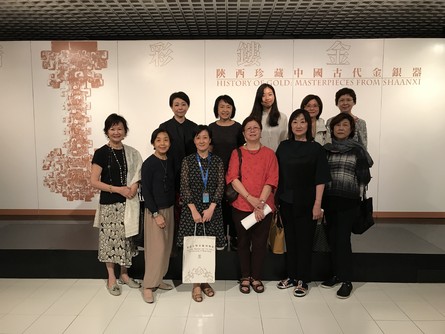
Guided Viewing of Two Exhibitions – History of Gold: Masterpieces from Shaanxi Golden Techniques: Art of the Chinese Goldsmiths With Dr. Xu Xiaodong

The two exhibitions “History of Gold: Masterpieces from Shaanxi and Golden Techniques: Art of the Chinese Goldsmiths” are presentations of the periodical achievements of the research project “Ancient Chinese Gold Techniques” co-presented by Art Museum of the Chinese University of Hong Kong (CUHK), Shaanxi Provincial Institute of Cultural Relics Protection, and Masters’ Workshop of Chow Tai Fook.

“History of Gold” features 60 pieces (sets) of carefully-selected ancient Chinese gold and silver works from 22 institutions of Shaanxi province, dating from 1000BC to 19th century. This exhibition endeavours to illustrate the development of gold-working techniques in ancient China, demonstrating, in the historical contexts, how gold-working techniques came to China from the West, integrated with Chinese techniques, and evolved into unique ways of working. In addition to examining the origin and development of ancient techniques, this exhibition will also try to reveal their historical and cultural significances.

“Golden Techniques” features over 40 pieces (sets) of ancient Chinese gold and silver wares from the collection of the Art Museum as well as private collections, and samples from reconstruction experiments as well as traditional goldsmith’s tools, both from the Masters’ Workshop of Chow Tai Fook, bringing the cutting-edge findings of ancient Chinese techniques used to make gold and silver objects, emphasizing on granulation (making gold granules and welding them onto the object) and gold wire techniques, as well as techniques used to make gold inlays.

Resource Person
Dr. Xu Xiaodong worked as keeper and researcher at the Palace Museum, Beijing from 2007-2013. Her research interests include history of Chinese jade, gold and silver, amber, imperial arts of the Ming and Qing dynasties and artistic interactions between ancient China and the West. She is currently Associate Director of the Art Museum, Associate Professor (by courtesy) of the Fine Arts Department, the Chinese University of Hong Kong

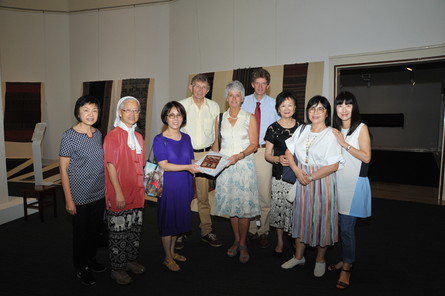
Guided Viewing – Fibres of Life: Ikat Textiles of the Indonesian Archipelago with Collector Peter ten Hoopen

Members are invited to join a private tour of the Pusaka Collection of Indonesian ikat with collector Peter ten Hoopen during his visit to Hong Kong. Presented at UMAG, the exhibition "Fibres of Life" and the accompanying publication of "Ikat Textiles of the Indonesian Archipelago" offer the community of textile collectors and enthusiasts the world’s first comprehensive overview of the profusion of ikat styles found across the archipelago.

The Pusaka Collection illustrates the concept of ‘unity in diversity’ that the young state of Indonesia chose as its motto on independence. The interwoven-ness of styles of neighbouring island regions matter, and so does their marked individuality and idiosyncrasy. This collection allows the study of the people’s finery as well as workaday attire.

Joint UMAG Public Lectures: Women in Art

We are delighted to organise two lectures on women in art, spanning centuries across continents. To register on-line, please visit:
https://hkuems1.hku.hk/hkuems/ec_hdetail.aspx?guest=Y&ueid=51739

Lecture I: "Staging Everyday Life and the Pleasures of Leisure: Images of Women in Qing Dynasty Chinese Painting" with Dr. Fongfong Chen
Generally known as "shinü hua" (gentlewomen paintings) or "meiren hua" (beautiful women paintings), paintings of women were a favourite theme in Chinese art from the eighth century onwards. This paper focuses on the depictions of objects, clothing, and architectural spaces as narrative modes in the pictures of women’s everyday lives in relation to their social roles. By looking at images of women in Qing dynasty paintings, this talk emphasizes the everyday and cultural lives of women in inner chambers and gardens. It argues that everyday life, in particular women’s leisure activities and hobbies, could be a significant aspect of gender analysis. Indeed, women were possibly both the audience for these images, as well as subjects of the male gaze, and positions their daily life within the literati culture of the Ming and Qing periods.

Speaker
Dr. Fongfong Chen is currently an Associate Curator at the University Museum & Art Gallery (UMAG) and an Honorary Assistant Professor at the Department of Fine Arts at the University of Hong Kong (HKU). She was a J.S. Lee Memorial Fellow (2013/2014) and a visiting scholar at the UC Berkeley Art Museum and Pacific Film Archive (BAMPFA), Berkeley, USA. Her research focuses on images of women and women’s fashions in different visual media in China from the eighteenth to the twentieth centuries. Her articles have appeared in academic journals and exhibition catalogues, including "Ming Qing Yanjiu", "Beauty Revealed: Images of Women in Qing Dynasty Chinese Painting", "Der Perfekte Pinsel: Chinesische Malerei 1300-1900 (The Perfect Brush: Chinese Painting 1300-1900)", and "Hong Kong Visual Arts Yearbook 2008".

Lecture II: "Why Women, Why Then, Why Now?" with Ms. Eliza Gluckman
Ms. Eliza Gluckman, Curator of the New Hall Art Collection at Murray Edwards College, University of Cambridge will talk us through its story, from the acquisition that spurred it in the late 1980s, to its continued importance today in the narrative of women artists and their careers. With over 500 works it is the largest collection of works by women in Europe. The artists represented include Barbara Hepworth, Tracey Emin, Paula Rego and Lin Tian Miao. The collection is currently looking at works by women artists in Hong Kong and working with a researcher and the Asia Art Archive to look at the last 50 years of women artists in Hong Kong. This lecture will consider the questions – Why women? Why then? Why now?

Speaker
Ms. Eliza Gluckman has an MA in Fine Art/ History of Art and an MA in Curating Contemporary Art (Royal College of Art). She has also worked in contemporary art for eighteen years, including in institutions such as Asia House and the Royal Society of Arts, and establishing a private institution and collection. In a freelance capacity Eliza has worked with the National Trust and museums including the Victoria and Albert Museum and Plymouth City Museum and Art Gallery. She has been Curator of the New Hall Art Collection – a new role established in June 2015 – for two years. In this time, she has helped to address and enhance aspects of organisational health, collection care and user experience, drawing heavily on her previous experience in exhibition display, curatorial research and audience development.
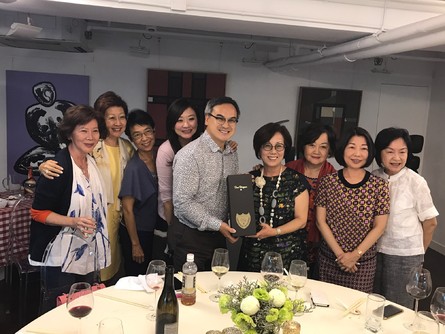
Special Event: Art + Culinary @ Asia One with Peter Lau and Catherine Lau

The Executive Committee invites you to a fun evening of "Art + Culinary" with the Managing Director of Asia One, Peter Lau and his wife Catherine.

Since its founding in 1997, Asia One Communications Group has become a leader of integrated communications services. Situated in a 14 storey industrial building, the headquarter is a laboratory for Peter Lau where he combines his passion for art with his flourishing business of printing and publishing.

A generous supporter of the Museum Society for many years, Peter will open the doors of his industrial complex and guide members through his world of art and publishing. We will visit the Asia One Book Center which showcases over 2,000 exquisite photography book titles from around the world; meander through the AO Vertical Art Space featuring works from legendary photographers Liu Heung Shing, Ho Fan and others; and savour a sumptuous dinner in Peter’s private gallery among his collections of artworks from traditional to contemporary Chinese artists including Zhang Daqian, Wang Keping and Ha Bik Chuen.

Before dinner, members can relax with wine and music on the rooftop terrace while Chef Nui Che roasts whole crispy piglets. She and her team will also prepare a feast of Cantonese and traditional village specialties including fried crab claws, salt baked chicken and grey mullet steamed with lime.

Join us for a great pre-summer gathering of art, wine, music and tasty culinary treats!

Guided Viewing: Hi! Houses: Jaffa Lam x Sam Tung Uk Museum

"Jaffa x Sam Tung Uk" is an ongoing, site-specific exhibition of sound, light and video installations created throughout the spacious Sam Tung Uk Museum, a restored Hakka village in Tsuen Wan. The work was one of four artistic installations ("Hi! Houses") to pay tribute to the long tradition and historical legacies of four monuments commissioned by the Hong Kong Arts Promotion Office. Jaffa’s unifying theme for her piece is inspired by the story of a missing calligraphy couplet which had been hanging in the original structure of Sam Tung Uk before its renovation, as she discovered from early photographs. The words of the missing couplet revealed the deep wisdom of Hakka elders who valued both education and the dignity of farming and traditional forms of livelihood.

Artist
Jaffa Lam received her BFA, MFA and Postgraduate Diploma in Education at The Chinese University of Hong Kong. She is now teaching at the Hong Kong Art School as Senior Lecturer. She is a sculptor specializing in large-scale site-specific works of mixed-media sculptures and installations, which are primarily made with recycled materials. In recent years, she has been involved in many public art and community projects in Hong Kong and overseas. Her works often explore issues related to local culture, history, society and current affairs.

https://www.lcsd.gov.hk/CE/Museum/APO/en_US/web/apo/hi_houses.html

Heritage Walk: Discovering Historic Stanley with Dr. Stephen Davies

Stanley, or Chek Chu 赤柱 is one of Hong Kong’s oldest settlements. Although situated on an isthmus between sheltered beaches facing north and east, and south and west, which is a classic choice for seagoing people, little is known about the territory until 1836 when the "Canton Register" described it as a “wretched village of poor fishermen”. This is certainly no longer the case as Stanley has flourished in the last 50 years with the rapid development of both luxury and public housing, resulting in a population growth 35 times greater than that in 1841!

Starting at the Stanley Military Cemetery, Dr. Stephen Davies will lead our group through the surroundings of historic Stanley Village. As we walk together, Dr. Davies will describe Stanley’s colourful history from its early origins as a modest fishing village, whose meagre wealth was used to build temples to Tin Hau, Shui Shin, and Pak Tai, the influence of notorious, legendary pirate, Zhang Baozai 張保仔, who together with his wife Ching Shi 鄭氏 or Chang I Sao 鄭一嫂, ran the largest ‘pirate’ fleet the world has ever known, its later settlement as a major British army base in the 19th century, and to its more recent history as a major battleground and internment camp during the Second World or Pacific War.

The “village” has one declared monument, not the 1767 Tin Hau Temple, but the 1859-1974 police station which is now a Wellcome Supermarket. In addition, Stanley boasts 41 listed buildings of which 40 are pre-war, and two “Heritage Hong Kong style” bogus reconstructions. Our itinerary will begin at the Military Cemetery (1933 with graves going back to 1842) and St. Stephen’s Beach (boundary marker 1844), and take us through Pat Kan Uk (Eight houses, mid-1930’s), Stanley Public Dispensary (1930s/1948), the old Post Office (1937), the old Police Station on Stanley Main Street (1859), glance uphill towards the Carmelite Convent (1933), Maryknoll House (1935), and Ma Hang Prison (converted 1930s government stores), the Shui Shin Temple (Qianlong 1836-95), Tai Wang/To Tei Temple and the Tin Hau Temple (1767). We will pass Murray House (1844/2002) and Blake Pier (1909/2007) and end at Pak Tai Temple (1805) before retracing our steps for lunch.

Resource Person
Dr. Stephen Davies, a Briton with family connections to Hong Kong that go back to the early 1930s, served in the Royal Navy and Royal Marines (1963-67), briefly designed atlases, and taught sailing and mountaineering before falling off a cliff and having to be screwed back together (1967-68). After university in Wales and London (1968-74) he taught political theory at the University of Hong Kong (1974-89). From 1990-2003 he and his partner sailed 50,000 miles visiting 27 countries in their 38’ sailing sloop; useful background for a maritime historian.

He was appointed the first Museum Director of the Hong Kong Maritime Museum in 2005. From 2005-2011 he built the collection and library, found the museum a new location, got government and donor funding for the expansion and relocation, and created the design and storylines for the new premises. In 2011, he was appointed the museum’s first CSSC Maritime Heritage Research Fellow.

Dr. Davies currently teaches a course on the sustainable use of heritage buildings at HKU’s Department of Real Estate and Construction, of which he is an Honorary Professor. He is also an Honorary Fellow of the University’s Hong Kong Institute for the Humanities and Social Sciences and an Honorary Editor of the "Journal of the Royal Asiatic Society Hong Kong". A prolific writer, Dr. Davies’s recent books are "Coasting Past: The last of South China coastal trading junks photographed by William Heering" (Hong Kong Maritime Museum 2013) and "East sails west: the voyage of the Keying", 1846-1855 (Hong Kong University Press 2014). He has just completed "Strong to Save: Maritime mission in Hong Kong from Whampoa Reach to the Mariners’ Club" to be published by Hong Kong City University Press in 2017 and is working on "Transport to another world: the life and times of HMS Tamar 1863-2015".