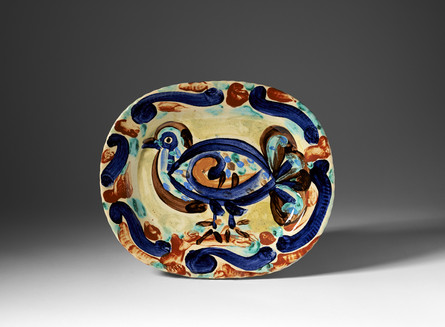
Don’t Miss – Closing Party with Lecture on Picasso’s Ceramic Oeuvre: of Owls, Pigeons and Corrida by Dr. Alma Mikulinsky

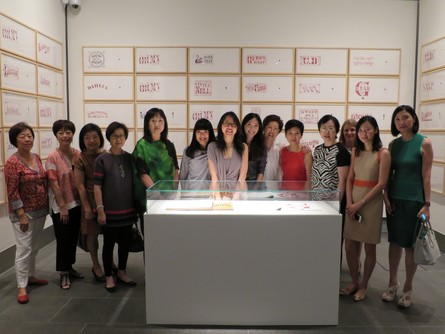
Do join us to bid a fond farewell to Picasso's ceramics from the Nina Miller Collection before its final closing. The evening starts with a wine-and-cheese reception where members and guests can toast to Picasso's artistic genius revealed in the beautifully sculpted and colourfully glazed ceramics. Co-curator of the exhibition, Dr. Alma Mikulinsky will present an insightful lecture on "Picasso's Ceramic Oeuvre: of Owls, Pigeons and Corrida" followed with a special guided viewing.

Synopsis
Pablo Picasso, originally known and celebrated as a painter, became a visionary
ceramic artist during the last three decades of his long and eventful life. In collaboration with ceramicists and sculptors, including Suzanne Ramié, Jules Agard and Julio Gonzales, he created an array of different forms and shapes of three-dimensional artworks, many of which served as sculptural canvas for his figurative paintings and ornate decorations. Many of the extraordinary and sometimes unique masterpieces the Spanish artist created are now part of the Nina Miller Collection and they are on display at UMAG this autumn. This talk offers insightful information on their origin and meaning, and it explains the sculptural and painterly decoration that set them apart.

In the south of France, the Spanish artist teamed up with Atelier Madoura and painted on both the ceramists standard forms fired and on artefacts Picasso helped to design—ones that show his individual style and relate to his painted and graphic oeuvre. In near series, the artist reinterprets objects and iconographic themes, elevating his newly adopted medium to rarely seen stature. Interesting hereby are his collaboratively produced sculptures, and the stylistic relationships across different media characteristic of Picasso’s distinct imprint and so iconic in the modern art of his day.

Speaker
Dr. Alma Mikulinsky is Assistant Professor of Modern and Contemporary Art History, at the Department of History, Duquesne University, Pittsburgh, USA and an independent curator working in North America, Europe, and Asia. Her PhD Dissertation (University of Toronto, 2011) was devoted to the photography of Pablo Picasso’s sculptures and she is currently working on a book manuscript titled Picasso on Display: The Public Life of Picasso’s Sculptures. She is the recipient of numerous awards and scholarships, among which a two-year post-doctoral fellowship as a research scholar at the Society of Scholars in the Humanities at The University of Hong Kong.
Sinicising Catholic Architecture in China and Hong Kong: the “Sino-Christian Style” and the Challenge of Inculturation with Dr. Thomas Coomans

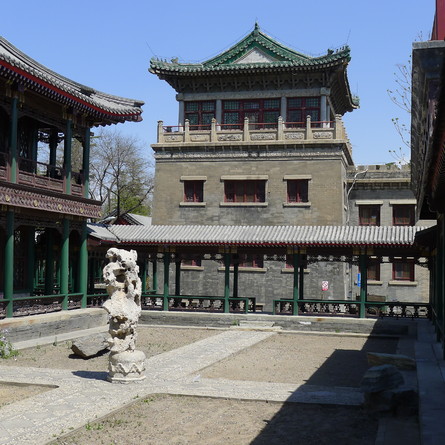
The policy of inculturation promoted by Pope Benedict XV in 1919 and implemented from 1922 in Republican China and Hong Kong by Archbishop Celso Costantini aimed to sinicise the Catholic mission and promote a Chinese Catholic church. Archbishop Costantini considered sinicising art and architecture a priority. Church architecture, as the most tangible expression of religion and identity in the public space, should express Chinese Christianity rather than Christianity imported by missionaries.

This lecture examines the paradigm shift of Catholic architecture in China and Hong Kong, from Western traditional models to Chinese-looking buildings, including modern structures in reinforced concrete. In 1926, the Vatican commissioned Father Adelbert Gresnigt, a Benedictine monk and artist, to define the “Sino-Christian style”. He designed several churches and educational buildings, his masterpieces being the Catholic University of Peking and the Regional Seminary of Hong Kong (present Holy Trinity Seminary at Aberdeen). This new style not only expressed Catholic Chineseness and modernity, but had to be different from the Protestants’ sinicised architecture. A debate, however, arose within the Catholic Church, many conservative missionaries arguing against the Sino-Christian style by referring to the preference of the Chinese Catholics for Western styles. An example of this debate happened in 1930 when St. Teresa’s Church Kowloon was designed.

From the early 1930s on, both the world economic crisis and growing political instability in China and Europe slowed down the architectural projects and redefined priorities. Contrary to architecture, the sinicisation of Christian art by Chinese artists and Western missionaries flourished until the 1940s.

Speaker
Dr. Thomas Coomans (PhD in art history and archaeology) is Associate Professor at the University of Leuven, Raymond Lemaire International Centre for Conservation, and Adjunct Assistant Professor at School of Architecture of The Chinese University of Hong Kong. His teachings include architectural history, theory and history of conservation. Combining research in western archives and fieldwork in
China, his present research and publications focus on the evolution of Christian church architecture in China from 1840 to 1950.

Fashion Forges the Nation: Dress in Eighteenth-Century Europe with Dr. Alicia Weisberg-Roberts

Fashion constitutes an important part of culture in every nation throughout history, and dressing is a vital expression of one’s individual personality in this modern world. Most people in Hong Kong wear western clothing, and looking into its roots of development is an interesting subject to explore.

In this lecture, Dr. Alicia Weisberg-Roberts will trace the development of dress in Western Europe, particularly in France and Britain, during the eighteenth century. She will examine the role of clothing and the textile trades in developing and defining national manufactures, political allegiances, and religious identity. Using garments, prints, drawings, painting and tracts from the period between 1660 and 1812, we will explore the impact of protectionism, industrialization and dissent in a period of burgeoning global exchange and international ferment.

Speaker
Dr. Alicia Weisberg-Roberts is an Honorary Assistant Professor at the University of Hong Kong where she teaches courses on European art and culture, including the history of fashion. Previously, she was Assistant Curator of Eighteenth- and Nineteenth-Century Art at the Walters Art Museum, Baltimore, and a Post-Doctoral Research Associate at the Yale Center for British Art. Her research focuses on the intersections of art, science and sociability in early-modern visual and material culture. She was co-editor and co-curator of "Mrs. Delany and Her Circle" (Yale, 2009) and has also contributed essays to "Horace Walpole’s Strawberry Hill" (Yale, 2009); "Knowing Nature: Art and Science in Philadelphia, 1740 to 1840" (Yale, 2011), and "Ways of Making and Knowing: The Material Culture of Empirical Knowledge" (University of Michigan Press, 2014). She is currently working on a book on cultural value of drawing in eighteenth-century France, as well as a project on the representation of non-European diplomats in seventeenth-century
Rome.

It Begins with Metamorphosis: Xu Bing with Dr. Yeewan Koon

We are delighted to organize a guided tour with the curator of this exhibition, Dr. Yeewan Koon. This is the first major solo exhibition of Xu Bing in Hong Kong, featuring some of the latest works by this renowned artist. The exhibition presented at the Asia Society Hong Kong Center will demonstrate how the transformative powers of materials and communication can prompt reflections on our day-to-day lives, personal memories, and collective histories. For example, in "Background Story", Xu Bing uses natural raw materials such as sticks and leaves set in a light box, to create, through their shadows, traces that appear to be similar to ink strokes of a Qing dynasty painting. "Ground from the Book" is an interactive artwork revealing a system of “language” told through icons and symbols as a new mode of communication. Both works have earlier precedents and also speak to one another. They provide insight to Xu Bing’s open-ended approach to art as he works through his own metamorphosis.

Xu Bing was born in Chongqing, China in 1955. He studied printmaking and graduated from the Central Academy of Fine Arts (CAFA) in Beijing in 1981 followed with a MFA in 1987. In 1990, he moved to the United States after receiving an invitation from the University of Wisconsin-Madison. Nine years later, he was the recipient of the prestigious MacArthur Award. In 2008, he returned to Beijing to take up the position of Vice-President of CAFA. His works have been exhibited in major institutions including the Arthur M. Sackler Gallery and the Smithsonian Institution in the USA, the Joan Miro Foundation in Spain, as well as 45th and 51st Venice Biennales and the Biennale of Sydney. In January 2014, Taipei Fine Arts Museum held a retrospective exhibition of Xu Bing’s works.

Speaker
Dr. Yeewan Koon is Associate Professor of the Fine Arts Department at the University of Hong Kong. Her book, "A Defiant Brush: Su Renshan and The Politics of Painting in Early 19th Century Guangdong" (2014) maps out the changes in painting during the time of the Opium War. She is currently working on her new research on emulations and fabrications of paintings that challenge ideals of the originals.

Queen’s College Old Boys’ Association

Established in 1862, Queen’s College is one of the oldest schools in Hong Kong. On their campus in Tin Hau lies the clubhouse of the Queen’s College Old Boys’ Association. Exclusive to alumni members, their Chinese restaurant renowned for serving delicious seasonal dishes, is opening their doors to us for this special dinner. On the evening, we will dine on a multiple course seasonal menu, one that will be set just prior to the event ensuring the freshest of ingredients.

Do come and join us on this special occasion!

Christie’s 2014 Spring Exhibition with Rosemary Scott and Pola Antebi

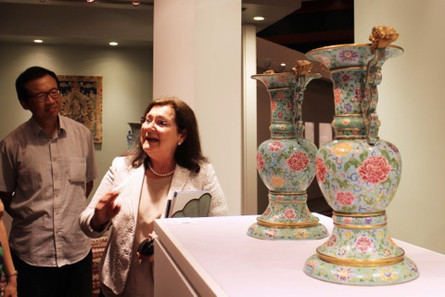
The Society is pleased to organise a gallery walk to view some of the exceptional works of art at Christie’s Spring Sales 2014. Rosemary Scott and Pola Antebi will guide us to view highlights from the Chinese Ceramics and Works of Art from this exhibition including some of the finest and rarest Ming and Qing dynasty porcelain and glass pieces, works of art for the imperial palace including a dazzling gilt-bronze vase inlaid with multi-coloured paste glass, rare imperial textiles, and much more. Members and friends are welcome to view the other galleries after the tour.

Rosemary Scott is Christie’s International Academic Director of Asian Art, who has successfully expanded Christie’s educational programs in Asian art, lecturing and conducting scholarly research for Christie’s Asian art sales worldwide. She holds an honors degree in Chinese Art and Archaeology from the University of London. Her career has spanned various important positions in her chosen field, including deputy keeper of the Burrell Collection, Glasgow, with curatorial responsibility for Oriental art; the curator of the Percival David Foundation, University of London; and head of the Museums Department of the School of Oriental and African Studies, University of London. Scott is also past president (2006-2009) of the London Oriental Ceramic Society.

Pola Antebi joined Christie’s Hong Kong in 1990. Since 2000, she has been the Department Head, as well as International Director of the Chinese Ceramics & Works of Art in Hong Kong, which has grown exponentially under her leadership. She travels extensively sourcing objects for sale, and has been instrumental in garnering some of the most prestigious private collections offered at Christie’s HK sales. Her areas of expertise include imperial ceramics, jades and works of art from the Yuan to the Qing periods. Antebi holds degrees in French Literature and Art History from the University of Vermont in the United States.

Broadway Musical Theatre throughout the Ages – An Interactive Performance with C. Kenneth Lee

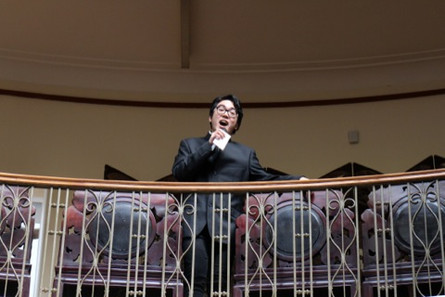
Do “Cabaret”, “Cats”, “Jesus Christ Superstar”, “The Phantom of the Opera”, “The Lion King”, “Les Miserables” and “Mamma Mia” sound familiar? Do you know how and when Broadway theatres and musicals started? What is Broadway, Off-Broadway, Off-Off Broadway? Which is the longest running Broadway musical in history and how many shows performed? What is a Tony Award? How did Broadway culture survive through the American Civil War, the Great Depression, and how was it affected when silent movies were replaced by movies with sound and special effects? Why is Broadway a good breeding ground for many famous movie stars? Come to this fun workshop and get the answers and stories from Kenneth Lee.

In 2013, the Broadway Theater District in New York City sold approximately US$1.19 billion worth of tickets with attendance at 11.58 million. Broadway is widely considered to represent the highest level of English-speaking commercial theatres. Kenneth Lee will showcase the evolution of musical theatre with his brilliant performance of specially selected songs, some of which will engage interactive singing with the audience. Everyone will probably go home humming familiar, heart-touching tunes.

Performer
C. Kenneth Lee is the Music Director of Jaderin Voice Group, and was a TVB music director/composer/performer for over 100 TV episodes. He has been an active award-winning performer, singer, pianist and composer in both the contemporary and classical domains since 1992. He is playing a leading role in the HK Musical production “Footloose” in May 2014 at the HK Cultural Centre.
Graduated from the California Institute of Art, Lee studied music under many international masters. He is Founder and first President of CMTC (Cal Arts Musical Theater Club). Hailed by The Hong Kong Economic Journal as “a young musical
prodigy”, Lee was awarded 1st place in The 6th Hong Kong Cup Arts Festival Singing Contest (adult classical singing division) in 2014, among numerous other awards in the past. He has performed internationally in concert halls, auditoriums, hotels, cruises, stadiums, festivals, radios and for special occasions. He teaches, composes, acts, writes and recently published his first book, "Selected Poems, Articles and Short Stories" by C. Kenneth Lee.

Three Cutting-Edge Architectural Projects in Hong Kong: Zero Carbon Building, Maggie’s Centre, and Xiqu Centre with Dr. Ronald Lu

Modern architecture highly values beauty, functionality and sustainability. Internationally renowned architect Dr. Ronald Lu will discuss these important qualities with three distinctive buildings in Hong Kong.

Zero Carbon Building (ZCB), Hong Kong

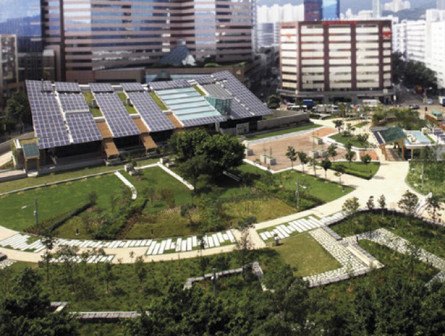
ZCB, the first zero carbon building in Hong Kong, is specifically designed for the subtropical urban context to showcase stateof-the-art eco-building design and technologies and to raise community awareness of sustainable living. Being “energy-plus”, ZCB generates on-site renewable energy to offset its operational energy consumption on an annual basis and exports surplus energy to the grid to offset its embodied energy. Priority is placed on energy demand control by effective passive building design and energy-efficient active systems to enable cost-effective implementation of renewable energy technologies.

Maggie’s Cancer Caring Centre, Hong Kong

Located at Tuen Mun Hospital, Maggie’s Cancer Caring Centre Hong Kong is the first Maggie’s Centre built outside of UK. Maggie’s Centre was inspired and set up by Maggie Jencks who had suffered and passed away from cancer. Like other Maggie’s Centres, Maggie’s Centre Hong Kong aims to provide a low-stress environment for cancer patients where they can receive information, advice and psychological support. Its unique connectivity with landscape and its expressive yet domestic architecture distinguishes it from the other Maggie’s Centres.

Working in collaboration with Frank Gehry, this centre, with a floor area of 468 sq. m., is composed of a living area, dining area, kitchen, large room for classes such as yoga, three counselling rooms and a staff office.

Xiqu Centre, Hong Kong

The Xiqu Centre will be the first of 17 core arts and cultural venues to be opened within the West Kowloon Cultural District. It will provide a platform for the Chinese opera communities to develop and produce the finest Cantonese and other Chinese opera performances; attract new audiences; collaborate with and host international cultural programmes.

Occupying a prime site of 13,800 sq. m. at the eastern edge of the West Kowloon Cultural District, the centre will be a gateway access to the West Kowloon Cultural District. The building will provide a striking entrance, a lantern for the West Kowloon Cultural District, embodying a covered public plaza and a dynamic treatment of the facade. Its flow or “qi” is expressed with curvilinear paths and forms. The architecture incorporates a generous amount of public leisure space, in addition to training and education facilities, a superbly designed auditorium for 1,100 and a 200 seat Tea House Theatre for performances. The project, working in collaboration with Bing Thom Architects, is scheduled to commence superstructure construction in 4th quarter of this year.

Speaker
Dr. Ronald Lu is the founder and chairman of Ronald Lu & Partners (RLP). With his commitment to professional quality and client services, he has nurtured the growth of RLP into an award-winning architecture and interior design practice. Spanning across almost four decades, RLP has become a household name in the industry of built environment in Hong Kong, and is continuously delivering world-class projects and green built environments across the globe. Dr. Lu obtained his first professional degree at University of New South Wales, Australia (UNSW), with a subsequent Master degree at Massachusetts Institute of Technology, USA and an Honorary Doctorate from UNSW, Australia. He believes in improving people’s lives through architecture and is actively involved in both professional and community circles. Dr. Lu is an active member for a number of Hong Kong and PRC professional organizations within the architecture industry. He is the past Chairman of the Hong Kong Architecture Centre, the past Presidents of the Hong Kong Institute of Architects as well as the American Institute of Architects Hong Kong Chapter.

Guest Speaker – Professor Peter Mathieson From Kidneys to Museums

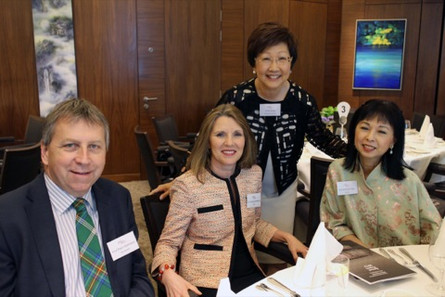
The University of Hong Kong Museum Society is delighted to present the new Vice Chancellor of The University of Hong Kong, Professor Peter Mathieson. In this talk Professor Mathieson will from his medical and research background as a kidney doctor illustrate the importance and complexity of this organ system, the relatively common nature of kidney disease and the highlights of some major recent progress in kidney research. Professor Mathieson will contrast the university systems in the United Kingdom and the rest of the world and explain why the opportunity to lead the University of Hong Kong is such an exciting privilege for him. He will also tell the audience something about himself and about his wife Dr. Christina Mathieson, the new Patron of the Museum Society, and their family. A very good chance for members to meet HKU’s charming first couple.

Speaker
Professor Peter Mathieson was born and educated in the United Kingdom. He attended a state grammar school in Penzance, Cornwall, becoming Head Boy in 1977. He was awarded an unconditional offer of a place to read Medicine at the London Hospital Medical College in 1978 and qualified from the University of London with First Class Honours in 1983. After junior medical posts in London, he obtained a research training fellowship from the Medical Research Council (MRC) to study at the University of Cambridge. He was awarded a PhD by the University of Cambridge in 1992. He then became Director of Studies for Clinical Medicine at Christ’s College, Cambridge.

After a further MRC fellowship he moved to Bristol in 1995 as the Foundation Professor of Renal Medicine at the University of Bristol and Honorary Consultant Nephrologist, North Bristol NHS Trust. Professor Mathieson was elected Fellow of the Academy of Medical Sciences in 1999. Between 2003 and 2007 he chaired the Research Grants Committee of Kidney Research UK. He was a member of the Renal Association Clinical Trials Committee from 1996 to 2007 and Chairman between 2000 and 2003. In 2007 he was elected as President of the Renal Association (the youngest ever!) in a competitive election by the membership and also became Head of the University Department of Clinical Science at North Bristol. In the same year he was appointed as Director of Research & Development for the North Bristol NHS Trust. He served the full three-year term as President of the Renal Association and remained a Trustee for a further two years as Immediate Past-President. In 2008 Professor Mathieson was appointed Dean of the Faculty of Medicine and Dentistry at the University of Bristol. Following the formation of Bristol Health Partners, he was appointed as the founding Director in May 2012, a role which he undertook alongside the role of Dean.

As of April 2014, Professor Mathieson has taken up the position of President and Vice Chancellor of the University of Hong Kong.