“Bonhams Auction 2016” With Victoria Huang

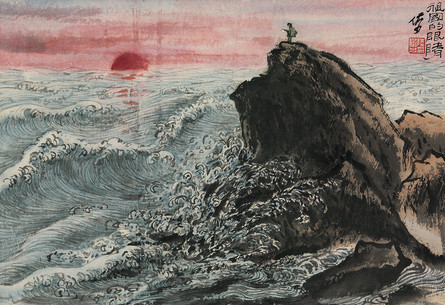
Bonhams Hong Kong will present a tightly-curated sale of Fine Chinese and Southeast Asian Paintings on 29 May 2016. Chinese masterpieces include works by Zhang Daqian 張大千, Lu Yanshao 陸儼少, Li Keran 李可染, Liu Haisu 劉海粟 and Huang Jun 黃均. Southeast Asian highlights encompass paintings by Adrien-Jean Le Mayeur de Merprès勒邁耶 and Bui Xuan Phai 裴春派.

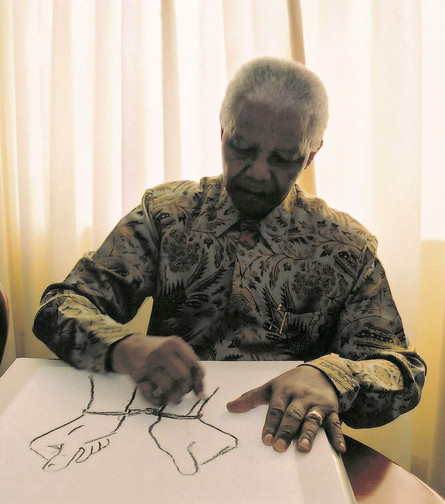
Notably, Bonhams will feature a rare artistic collaboration between Nelson Mandela 納爾遜 · 曼德拉 and Tan Swie Hian 陳瑞獻. Six powerful images of the hands and arms of Nelson Mandela sketched by the great politician himself – which were then lithographed and painted upon by acclaimed Singaporean artist Tan Swie Hian – will be sold as a set with a customised box and framed as a cohesive series. This set of six collectively known as The Nelson Mandela Unity Series, signed individually by both, is unique in medium, meaning and technique — original acrylic, ink and pencil over monochrome lithography. Tan reinforced Mandela's nobility of the human spirit by using Buddhist mudras (symbolic hand gestures) and Chinese calligraphy in the cursive script. This exceptional series was formerly in the collection of Nelson Rolihlahla Mandela, thereafter by direct descent to his eldest daughter Pumla Makaziwe Mandela.

Resource Person
Victoria Huang is currently based at the Bonhams Singapore office. She is responsible for the Asian painting portfolio as she develops her client base in Singapore and the region. Victoria has a BA degree in Asian Studies from Scripps College, California. In 1997, she received her MA in Art History and Archaeology from Columbia University, New York, where she specialised in Chinese paintings of the Ming and Qing dynasties. To increase her strategic understanding of art museum and gallery management, she completed her second MA degree at the University of Leicester, United Kingdom, in 2010, where she received distinction for her thesis on branding university museums.

In between her degrees, she worked in education and the arts. Victoria was an assistant curator at the Singapore Art Museum from 2005 to 2007, where she oversaw the development of artefact donations, prepared catalogue production and curated or jointly-curated exhibitions on Singapore and Southeast Asian art including Encounters: Southeast Asian Art in Singapore Art Museum Collection, Legends: Soo Bin's Portraits of Chinese Ink Masters and W.S. Hoong's Art of Seal-Carving: A Kong Chow Wui Koon Donation Exhibition. In 2012, she was selected by Singapore's Economic Development Board (EDB) and Bonhams to undergo specialist training in sourcing, authentication, valuation and cataloguing of classical and 20th Century Chinese paintings as well as Southeast Asian art under the 2-year Strategic Attachment and Training Programme funded by EDB.

“Rubbings and Chinese Calligraphy” (碑帖拓本與中國書法) With Professor Yunwoon Lee (李潤桓教授)

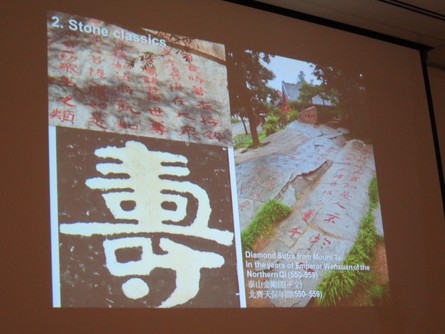
碑帖拓本為我國特有的一種保存及傳播文字的方法。“記功立石”、“立碑刻銘”、“縑竹易銷”,“金石難滅”,所以自古以來,文化的流傳,特別是大規模的工作都以石刻作為工具。儒家的漢代熹平石經,魏正始三體石經,釋家的北朝的佛經摩崖碑刻,多不勝舉,而其書寫文字更為書法範本的重要部份。其他如周石鼓、秦刻石、漢魏碑刻、隋唐名碑,更是中國書法藝術的瑰寶。自宋代的著名名人書法家墨跡上石,開將出現叢帖,宋太宗淳化秘閣法帖,實為法帖之袓。以後連綿不絕,更加影響歷代書法的發展。

不過書寫作品在上石傳刻的優劣與及原刻挖改或翻刻,乃至拓本傳拓時間的先後,早晚對觀者或學習者又有很大的影響。而作為文物,藝術品則拓本的真偽,孤本、善本、原刻本、翻刻本,其價值上下差落又極大。這些都是不能不注意的問題。

本講座會引用不同年代的書法拓本作例子,探討中國書法的歷史和書體發展脈絡。

In the past, rubbings were used as a way to preserve and disseminate texts and Chinese characters. For example, records of someone’s merits and important events were often cut into stone, which is inherently more long lasting than the more fragile silk and bamboo strips. Therefore, rubbings played an important role in the spread of culture in imperial China; in particular, with large-scale cultural projects that involve multiple texts.

Professor Lee will speak about the history of Chinese calligraphy, using rubbings as a way to illustrate different script-styles and their developments. The appreciation and authenticity of Chinese rubbings also will be covered.

Speaker
李潤桓教授畢業於新亞書院藝術系,獲香港中文大學學士及香港大學哲學碩士(中國美術)。李氏為前香港中文大學藝術系系主任、教授,香港中文大學文物館名譽研究員,現任香港特別行政區康樂及文化事務署博物館專家顧問(中國書畫)、中國書協香港分會特邀顧問、香港蘭亭學會藝術顧問、香港書法家協會藝術顧問。李氏著有:《李潤桓書畫集》、《國畫入門》(合著)、《倪瓚生平研究》、《倪瓚書跡研究》、〈傳世倪瓚書畫的幾個問題〉、〈沈周師承及其有關問題〉、〈淳化閣帖傳世宋本辨〉、〈楷書略說〉等。

Professor Yunwoon Lee graduated from the Department of Fine Arts, New Asia College of the Chinese University of Hong Kong (CUHK). He received an MPhil in Chinese Arts from the University of Hong Kong (HKU). He was Head and Professor of the Department of Fine Arts of CUHK, honorary research fellow of the Art Museum CUHK, and art advisor for the Hong Kong Arts Development Council (Dept. of Visual Arts). He is now Museum Expert Adviser (Chinese Painting and Calligraphy) of the Leisure and Cultural Services Department of HKSAR, special advisor to the Chinese Calligraphers Association of Hong Kong, and Art advisor for the Hong Kong Lan Ting Society and the Hong Kong Calligraphers’ Association.

“Masterpieces of British Silver: Highlights from the Victoria and Albert Museum” With Ben Chiesa

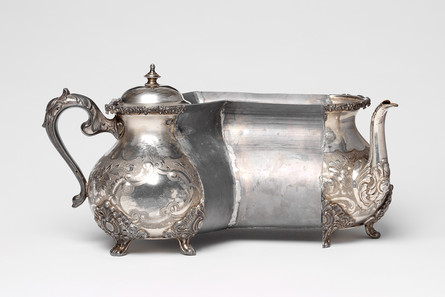
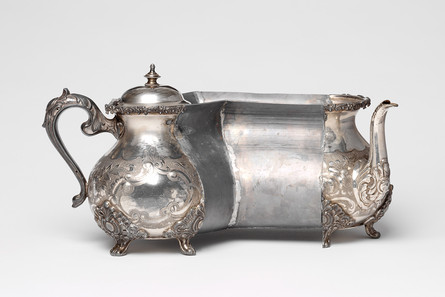
The contemporary expression of this tradition is explored through thirty-nine dramatic sculptural pieces from the V&A’s permanent collection, showcased alongside original designs and sketches. Ranging from the entirely abstract to the startlingly representative, conceptual and functional pieces by modern day masters of silver such as David Clarke, Michael Rowe, Gerald Benney and Michael Lloyd demonstrate the diverse influences from which contemporary silverwork in Britain draws inspiration – from the flowery ostentation of eighteenth century Rococo to the minimal simplicity of Scandinavian design.

“This is a unique opportunity to see masterpieces of silver from the privately assembled Gilbert Collection before the V&A’s Gilbert Galleries reopen to the public in London in November”, writes Dr Tessa Murdoch, Head of Metalwork Collections at the V&A. “The graceful silver swan epitomizes Arthur Gilbert’s taste; he collected the very best examples of historic silver from the famous London workshops of Paul de Lamerie and Paul Storr and from the most celebrated historic collections. William Beckford had his Chinese Qianlong coffee pots embellished with silver-gilt mounts in London in 1820. The Gilbert curators continue to add to this prestigious collection; their latest acquisition, a royal Christening gift presented in 1731 by King George II to his goddaughter Lady Emily Lennox, was purchased at Europe’s most famous art fair, TEFAF, Maastricht, 2014.”

Resource Person
Ben Chiesa is the curator of Liang Yi Museum, an institution dedicated to promoting design, craftsmanship and heritage in Hong Kong. Since joining the museum last year, he has worked on Scholars and Debutantes: A Contrast of Aesthetic and Opulent Luxuries as well as the newly opened Masterpieces of British Silver: Highlights from the Victoria and Albert Museum. He received his MA in art and archaeology from University College London in 2010.

Ben previously served as curator of cross-cultural art at the Asian Civilisations Museum, Singapore. His past exhibitions include China Mania! The Global Passion for Porcelain, 800-1900 and Auspicious Designs: Batik for Peranakan Altars. He co-authored several of the museum's major publications, including Enlightened Ways: Buddhist Art from Thailand and a catalogue accompanying Auspicious Designs. His research focuses on Chinese and Japanese furniture and decorative art made for export from the sixteenth to nineteenth century.

“Heritage Conservation and Private Museums” Guest Speaker – Pro-Vice-Chancellor Douglas So

The Executive Committee is delighted to present Mr. Douglas So, Vice-President and Pro-Vice-Chancellor of The University of Hong Kong in charge of institutional advancement as the guest speaker at this year’s AGM. With a passion for photography and heritage conservation, Douglas will share with us the journey of establishing the F11 Photographic Museum inside a Grade III heritage building in Happy Valley, including an overview of the history, the conservation philosophy and efforts, design, vision and mission, and the difficulties encountered.

The aim of the presentation is to generate thoughts and ideas on the way forward for heritage conservation and revitalisation, as well as a discussion on the opportunities arising from an increasing number of private museums in Hong Kong and the challenges they face.

Speaker
Douglas So is the Vice-President and Pro-Vice-Chancellor of The University of Hong Kong in charge of institutional advancement. Trained as a solicitor, Douglas is admitted to practice in Hong Kong, as well as in England and Wales.

Douglas is passionate about photography and heritage conservation. He has been collecting cameras, photographs and photo books for nearly 20 years. During his tenure as Executive Director, Charities at the Jockey Club from 2010-2014, he was involved in a number of projects relating to arts, culture and heritage including the Central Police Station, Le French May, Hong Kong Arts Festival and various major exhibitions across Hong Kong.

Douglas is the founder and director of F11 Photographic Museum (www.f11.com), which resides in a Grade III heritage building at 11 Yuk Sau Street in Happy Valley. Opened in September 2014, F11 is the first and only museum in Hong Kong dedicated to the promotion and appreciation of photography. There are exhibitions on photographs, cameras and books, as well as seminars and master classes, held at F11 periodically.

Douglas is also keen to serve the community. Currently, he serves on a number of boards and committees including the HK Community Chest, UNICEF, HK Phil, HK Cyberport, Food Angel, History Museum Advisory Panel and Duchess of Kent Children’s Hospital.
Masterpieces of British Silver: Highlights from the Victoria and Albert Museum With Ben Chiesa

The contemporary expression of this tradition is explored through thirty-nine dramatic sculptural pieces from the V&A’s permanent collection, showcased alongside original designs and sketches. Ranging from the entirely abstract to the startlingly representative, conceptual and functional pieces by modern day masters of silver such as David Clarke, Michael Rowe, Gerald Benney and Michael Lloyd demonstrate the diverse influences from which contemporary silverwork in Britain draws inspiration – from the flowery ostentation of eighteenth century Rococo to the minimal simplicity of Scandinavian design.

“This is a unique opportunity to see masterpieces of silver from the privately assembled Gilbert Collection before the V&A’s Gilbert Galleries reopen to the public in London in November”, writes Dr Tessa Murdoch, Head of Metalwork Collections at the V&A. “The graceful silver swan epitomizes Arthur Gilbert’s taste; he collected the very best examples of historic silver from the famous London workshops of Paul de Lamerie and Paul Storr and from the most celebrated historic collections. William Beckford had his Chinese Qianlong coffee pots embellished with silver-gilt mounts in London in 1820. The Gilbert curators continue to add to this prestigious collection; their latest acquisition, a royal Christening gift presented in 1731 by King George II to his goddaughter Lady Emily Lennox, was purchased at Europe’s most famous art fair, TEFAF, Maastricht, 2014.”

Resource Person
Ben Chiesa is the curator of Liang Yi Museum, an institution dedicated to promoting design, craftsmanship and heritage in Hong Kong. Since joining the museum last year, he has worked on Scholars and Debutantes: A Contrast of Aesthetic and Opulent Luxuries as well as the newly opened Masterpieces of British Silver: Highlights from the Victoria and Albert Museum. He received his MA in art and archaeology from University College London in 2010.

Ben previously served as curator of cross-cultural art at the Asian Civilisations Museum, Singapore. His past exhibitions include China Mania! The Global Passion for Porcelain, 800-1900 and Auspicious Designs: Batik for Peranakan Altars. He co-authored several of the museum's major publications, including Enlightened Ways: Buddhist Art from Thailand and a catalogue accompanying Auspicious Designs. His research focuses on Chinese and Japanese furniture and decorative art made for export from the sixteenth to nineteenth century.

M+ Sigg Collection: Four decardes of Chinese Contemporary Art With Isabella Tam

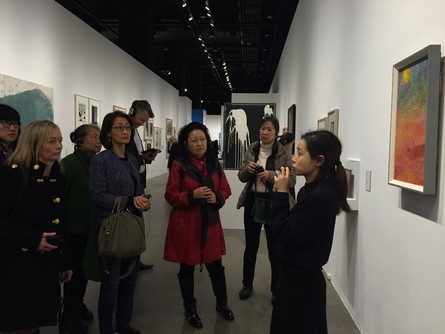
The HKUMS is delighted to organize a special guided viewing of "M+ Sigg Collection: Four Decades of Chinese Contemporary Art" with assistant curator Isabella Tam. A cornerstone of the M+ Collection, this exhibition will trace the emergence and the development of Chinese contemporary art since the late period of Cultural Revolution, to the radical experiments in the 1990s, and the vibrant art scene of present-day China. Comprising around 80 seminal works of various formats – painting, sculpture, video and installation – the exhibition offers multiple entry points and crystallises one of the most remarkable art historical phenomena from the last part of the 20th century.

Resource Person
Isabella Tam is currently the Assistant Curator at M+ in Hong Kong. Her role involves acquisition and curating exhibitions to reflect the inter-disciplinary content of M+ and its visual culture mandate. At M+ her project includes "Mobile M+: Inflation!" (April–June 2013) and "Song Dong: 36 Calendars" (Jan–Feb 2013). Prior to joining M+, she was Assistant Curator at the Legislative Council and the Hong Kong Visual Arts Centre, commissioning artists to produce public artworks and curated sound art project, "I/O Flows" (2006) and media performance, "Dorkbot: Live" (2009). She was a Whitechapel-British Council Hong Kong curator at the Whitechapel Gallery in London (2012), and author of "Glow in the Dark" (HK: Videotage, 2009), "Veil Unveil: works of Tang Ying Chi" (HK, 2010), and "Right is Wrong: Four Decades of Chinese Art from the M+ Sigg" Collection (Umea, Sweden, 2014).

Saturday Guided Walk through Upper Sheung Wan & Sai Ying Pun With Cheng Po Hung (鄭寶鴻)

中上環及西營盤懷舊遊路線 :

途經 : 閣麟街,擺花街,荷李活道,鴨巴甸街,士丹頓街,必列者士街,太平山街,皇后大道西。

可考察早期的戲院,中環街市,中央書院,華人居住區,疫區,東華醫院,水坑口街和佔領角,國家醫院及西營盤的舊日風貌。

Overview
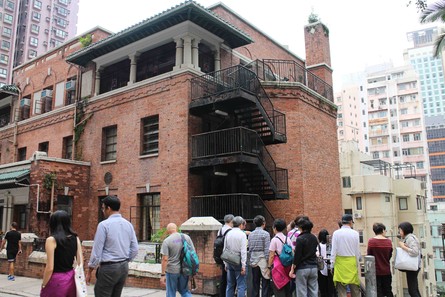
Cheng Po Hung, UMAG honorary advisor and renowned Hong Kong historian will guide us through the districts of upper Sheung Wan and Sai Ying Pun. This is a continuation of Cheng's previous walk last year where we explored Causeway Bay, Tin Hau and North Point. On this walk we will meander through one of the oldest parts of Hong Kong passing Cochrane Street, Lyndhurst Terrace, Hollywood Road, Aberdeen Street, Staunton Street, heading West towards Bridges Street, Tai Ping Shan Street and finally Queen’s Road West. He will share interesting tales about old landmarks including the one of the earliest cinemas in Hong Kong, Central Market, the Central School, the residential area where Chinese people lived, location of the plague in the late 1900s, Tung Wah hospital, Possession Street. & Possession Point, the Government Civic hospital as well as the historic parts of Sai Ying Pun.

“Golden Light of the Buddha — Art and Architecture of Tōhoku, Japan” With Professor Puay-peng Ho

Synopsis
The far north of Japan was the native land of the Emishi 蝦夷 people, descendants of the Jōmon 繩文. Largely a land of abundance with a central mountain range Ōu Mountains 奥羽山脈, it was conquered by the Yamato 大和 regime from Central Japan and included in the territory of Japan after some bloody battles between 7th – 9th centuries. Since then, feudal lords ruled over the land with two main provinces: Ōshū 奥州 or Michinoku 陸奥 or 道奥, meaning “End of the Road”, to the east and Ushū 羽州 or Dewa no kuni 出羽国 to the west. Understandably, the religion and practices of this far-flung territory of Japan maintained a balance between the imperial and cosmopolitan school and style of Kyoto, the capital, and the local characteristics. The worship of mountain is one example, and the belief in Pure Land Buddhism is another. The main mountain for the practice of Shugendō 修験道 in the vast natural landscape of Tōhoku is Mount Haguro 羽黑山, the fusion of imported Buddhism and indigenous mountain worship.

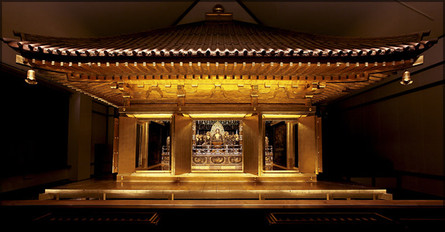
In the early eras of the unification of Michinoku, in addition to the military and government, Buddhism was an important tool through which the aboriginal people of the far north would be assimilated. Ennin 圓仁, later given the title of Jikaku Daishi 慈覺大師, was asked by the emperor to send 3,000 students from Enryakuji 延暦寺 in north Kyoto to Matsushima 松島 in Miyagi province. They were housed in the newly established Zuiganji 瑞嚴寺 monastery which continued to received imperial and local shogun’s support in this beautiful region of Tōhoku. While Ennin, who traveled to China in the 9th century, was well known as establishing a solid basis for esoteric practices in Tendai 天台 lineage learned from his Chinese experience, he also introduced the Pure Land practices to Japan. The following era in Tōhoku during the 100 years rule of the four generations of Fujiwara 藤原 aristocracy between 1087-1189, saw the creation of monasteries in the Pure Land tradition in the region, principally in Hiraizumi 平泉. Most of these monasteries no longer exist, but the only survival, Chuzonji 中尊寺 monastery with its golden hall, epitomized the belief in the blissful land of Buddha Amitābha.

Presented in conjunction with the Museum’s Society’s upcoming trip to Tōhoku, this lecture will outline the social-political dynamics of Tōhoku during the medieval period and trace the development of Buddhism in this region. The form of Buddhist practice in this backwater of Japan is magnificently expressed in the art and architecture. While Kyoto craftsmen and builders were invited by aristocracies to work in the highest form of art and architecture in this region, there were also local expressions which were tied firmly to the natural beauty of Tōhoku.

Speaker
Professor Puay-peng Ho is Professor and Director of the School of Architecture, and Director of Centre for Architectural Heritage Research at The Chinese University of Hong Kong. He received his First Class Honours degree in Architecture from the University of Edinburgh and a Ph.D in Art History from the School of Oriental and African Studies, University of London. Professor Ho is a member of the Royal Institute of British Architects and the Society of Architectural Historians. Currently, he serves on the Town Planning Board, Antiquities Advisory Board and History Museum Advisory Panel, and is Chairman of the Council of Lord Wilson Heritage Trust. His research interests and publications are in the areas of Chinese art and architectural history, vernacular architecture, and architectural theory. He is also involved in many architecture conservation projects in Hong Kong.

Rendering Change: The Arts of New China 1949-79 With Catherine Maudsley

The HKUMS is delighted to present this special guided viewing of Rendering Change: The Arts of New China 1949-79 with co-curator Catherine Maudsley. After the viewing, participants are invited to savour a 6-course lunch with Catherine among the exhibited art works at Duddell’s private dining room.

Exhibition — Rendering Change: The Arts of New China 1949-79
For more than twenty-five years, the M K Lau Collection has assembled one of the finest private collections of Chinese ink and brush paintings, calligraphy, watercolours and prints documenting defining moments of New China. The art explores this special era’s social landscape and promotes a multi-perspective view of the art, culture and history of New China through a comprehensive collection of exceptional works. Its exhibition of New China’s ink paintings, numbering over 100 works featuring 55 renowned Chinese artists, was shown to great acclaim in 2015 at the Hong Kong Arts Centre, the Dadu Museum, Beijing and the Long Museum – West Bund, Shanghai.

Resource Person
Catherine Maudsley, a Hong Kong-based art historian, art consultant, curator, educator and writer, has had a long association with the M K Lau Collection. A multiple award winner, she was a Connaught Research Scholar at the University of Toronto, a Canada-China Scholar in Beijing and a Commonwealth Scholar in Hong Kong. She has published and lectured extensively on Asian art and culture. Catherine has taught at the Department of Fine Arts, The University of Hong Kong and has served on the Executive Committees of the University of Hong Kong Museum Society and the Hong Kong Oriental Ceramic Society and is a Council Member of the Hong Kong Art School.

About Duddell’s
Duddell’s is a cultural and social destination created for people who have an active appreciation of the arts. With interiors as noteworthy as the art on its walls, entering Duddell’s feels like being welcomed into the home of a great art collector – one that also happens to have an in-house Michelin-starred Cantonese chef and a lush 2,000 square foot Garden Terrace.

Unravelling Flemish Tapestries Through Formal Art Historical Network Research With Professor Koenraad Brosens

This lecture introduces the history of Flemish tapestry weaving, arguably the most celebrated art production in early modern Europe. Many of the most prestigious series of large pictorial textiles were produced in collaboration with different weavers sharing the work and associate costs. This interesting phenomenon led to a new type of research focusing on the socio-economic relationships. MapTap, an ongoing research project developed by Professor Koenraad Brosens, studies the interplay between social structure and dynamics on the one hand, and artistic developments in Flemish tapestry of the seventeenth and eighteenth centuries on the other.

By developing a case study that zooms in on two mid-17th century Brussels tapestries, we will catch a glimpse of the complex socio-economic reality behind the medium, and find that “network(s) of cooperative links among participants” (Becker, Art Worlds, 1982) underpinned, fuelled and steered the tapestry industry. We will then address the question emerging from this observation: How can we reconstruct and study these networks properly? What would be a fitting methodology, technique or tool?

Speaker
Koenraad Brosens is Research Professor in the History of Art Department at KU Leuven where he teaches European Tapestry, Art and Economics, Costume and Fashion and 19th-Century European Art. As a Research and Teaching Assistant at KU Leuven (1998-2003) and a Postdoctoral Fellow of the Flemish Fund for Scientific Research-Belgium (FWO Vlaanderen) (2003-2009), he focused on entrepreneurial strategies devised by early modern European tapestry producers. Professor Brosens has published widely on 17th and 18th century Flemish and French tapestry. His bibliography includes A contextual study of Brussels tapestry, 1670–1770, The dye works and tapestry workshop of Urbanus Leyniers,1674–1747 (2004), European Tapestries in The Art Institute of Chicago (2008), Rubens: The Constantine Series (Corpus Rubenianum Ludwig Burchard, XIII) (2011), and several articles in peer-reviewed journals. He is now working on a book on painting and tapestry in 18th-century Brussels.