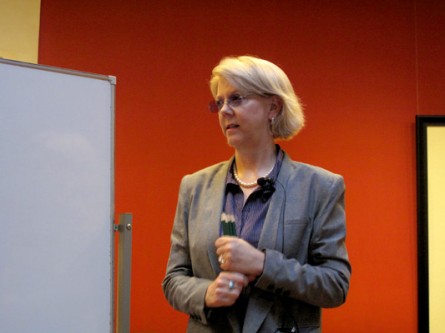
Stacy Gould on ‘To have and to Hold Or To Throw and Say Goodbye?’

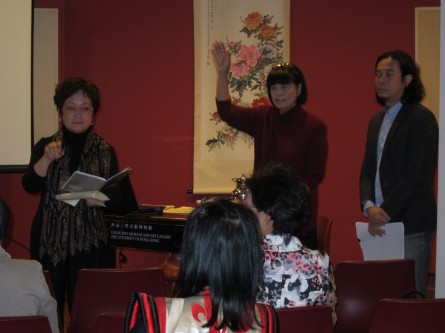
Stacy Gould will present an informal talk on the concept of archives and what archivists do, as well as offer suggestions on when to send your things to a professional archive and when not to. How does one donate one's records? Are there personal records worth preserving and if so, what are the basic theories behind preservation? How do you preserve and maintain your family "archive"?

The talk will be followed by a question and answer session. Participants may bring in examples of records/photos and artefacts, and ask specific questions that we hope will lead to more general answers that everyone can benefit from.

Speaker

Stacy Belcher Gould has been an academic archivist for 20 years. She trained at Wright State University and received her MA in 1991. She interned at the Cincinnati Art Museum and at the Biltmore House in Asheville, North Carolina. From there, she pursued post-graduate study at the University of Michigan and the Rare Book School at the University of Virginia, as well as continuing education sponsored by the Society of American Archivists. Certified in 1994 by the Academy of Certified Archivists, she is also a member of the SAA and the International Council on Archives.

Before arriving HKU to establish the University Archives in 2006, Gould had been the University Archivist and State Records Officer at the College of William and Mary in Virginia, which was founded in 1693. She is one of the founding members of the Archives Action Group here in Hong Kong, and a member of the subcommittee that drafted the proposed legislation for an archives law for the HKSAR.

‘Picasso’s Unknown Masterpieces’ with Dr. Alma Mikulinsky

While Pablo Picasso is often praised as the most important painter of the 20th century art world, his sculptures receive significantly less attention and fame. The reason for this imbalance seems to stem from Picasso's own strategies of display. During his lifetime, the artist internationally exhibited his paintings, while choosing for the large part of his career to leave his enormous collection of sculptures "in the dark". The sculptures were never sold or exhibited, and for the most part were left in Picasso's private houses, studios, and storage rooms, for his eyes only.

In this talk, we will examine Picasso's unknown masterpieces and attempt to decipher the reasons for Picasso's peculiar approach to the display of his sculptures.

Speaker

Dr. Alma Mikulinsky is a Research Fellow at the Society of Scholars in the Humanities at the University of Hong Kong. She specializes in early 20th century European art with additional expertise in international contemporary art. While her current book project is devoted to the study of photographic represntation of Pablo Picasso's sculptures, her research interests encompass interwar continental philosophy, early 20th century ethnographic discourses, strategies of art display, and art and politics. She has been the recipient of, among others, a residence scholarship at the Canadian Center for Architecture in Montreal, and a graduate fellowship at the Jackman Humanities Institute at the University of Toronto. Alongside her academic work, she acts as an art consultant and translator, and writes art critiques and exhibition reviews. Her texts and translations have been commissioned by international museums and prominent ccommercial galleries.

Home Visit – Mimi Hung

The Museum Society is honoured to visit the home of Mimi Wong Hung and view her internationally renowned Hung Collection of Ming and Qing Chinese furniture.

Mimi is the great-granddaughter of Wang Yi Ting, also known as Wang Zhen (1867-1938), who was the former Chairman of the Buddhist Society in Shanghai. A distinguished painter of Buddhist images, his works had been sold at international auction houses. A thesis about him was also published in 2000 by The University of Hong Kong. Her family hosted Albert Einstein during his well-publicized visit to China on transit to Japan.

After living overseas for a period of time, Mimi returned to Hong Kong in 1973. With the profits from a successful electronic manufacturing business, she and her former husband started acquiring Chinese furniture in 1985 as a need to furnish their home. That was the beginning of a long and passionate journey into Chinese furniture collecting. It was also a very opportune time as she was able to pick up what others threw away. With her sincerity and enthusiasm, she made many good friends who assisted her in forming the Hung Collection. Some of her pieces were exhibited in 1998 at the San Francisco Asian Art Museum along with a published catalogue, Essence of Style.

Robert H. Ellsworth who privately catalogued Masterpieces of David and Peggy Rockefeller Collection in 1994, had also catalogued the Hung Collection in 1996 and 2005, producing two volumes titled, Chinese Furniture: The Hung Collection. Together, they form some of the most important books on Chinese furniture.

During our visit, we will hear her stories about the various exquisite and rare pieces in her collection, and see how she has tastefully arranged these pieces in her home.

2011 Hong Kong & Shenzhen Bi-City Biennale of Urbanism/Architecture in Hong Kong with Joan Leung (Part 2)

Hong Kong & Shenzhen Bi-City Biennale of Urbanism/Architecture was inaugurated in 2007, generating synergy between the two most vibrant urban centres in the region, Hong Kong and Shenzhen. In January, under the guidance of Hong Kong architect Joan Leung, we visited Shenzhen's 2011 Bi-City Biennale, curated by Terrence Riley with the theme – architecture creates cities, cities create architecture. Many participants expressed keen interest and in response, Leung has kindly agreed to guide a sequel tour to the Hong Kong part of the Bi-City Biennale.

The Hong Kong Bi-City Biennale is curated by Gene K. King and Anderson Lee, and embraces the theme, Tri-ciprocal Cities: The Time, The Place, The People. Drawing an analogy between the development of a city and the biological age of a person, it addresses the tangible as well as the intangible aspects of the city and its architecture – factors that shape the character and vitality of the city.

The Biennale will be held at the HK Kowloon Park and HK Heritage Discovery Centre in Tsim Sha Tsui. It comprises a series of multi-media activities that includes performances, movie appreciation, forums and workshops with participation from 50 architects, designers and artists from Hong Kong, Asia and Europe.

The HKU Museum Society and the Friends of the HK Art Museum will again jointly present the tour. Our guide Joan Leung is a graduate with a M. Arch degree from MIT. She was a faculty member of HKU Architecture Department until she founded Lotus Architects Ltd in 1987 with her late husband, Professor Eric Lye, Dean and Head of HKU Architecture. Since then, she has done many notable projects, including the Clubhouse at the Arch, which won the Grand Award of Quality Building Award for 2008. She is a member of the West Kowloon Cultural District Advisory Committee and the Heritage and Conservation Committee, and has published papers on architecture education, interior architecture and green building.

‘Korean Contemporary Artists in the Global Art Scene’ with Jiyoon Lee & Seoul Auction’s Spring 2012 Exhibition

In commemoration of its 9th auction in Hong Kong, Seoul Auction is presenting a special lecture by the Korean curator, Jiyoon Lee on 'Korean Contemporary Artists in the Global Art Scene', followed by a guided tour of Seoul Auction's Preview Exhibition to our members.

The lecture will be an overview of major Korean contemporary artists and how they have come to prominence in today's international art scene. The preview exhibition of Seoul Auction will feature modern and contemporary art from major artists in Asia, as well as Europe and the US.

Established in 1998, Seoul Auction is the oldest and largest art auction firm in Korea. In 2008, the company opened a branch in Hong Kong, Seoul Auction HK Ltd., and since then, has successfully held eight major auctions dealing in global modern and contemporary art.

Speaker

Jiyoon Lee is an adjunct professor at Yonsei University, Seoul, Korea and the Founding Director of Suum Project, a contemporary art consultancy firm based in both Seoul and London. As one of the most recognized independent curators today, Lee has curated numerous exhibitions, including Korean Eye for the Saatchi Gallery, London and the Korean section of the Venice Biennale in 2009. Lee also serves as the Art Director for Art:Gwangju, a media-art fair based in Gwangju, Korea.

The Legislative Council Complex with LegCo Secretary General Pauline Ng

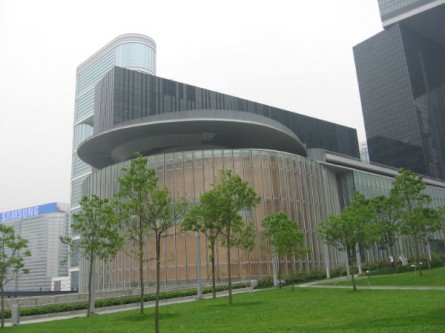
The new Legislative Council (LegCo) Complex is the first purpose-built building to house the Legislature of Hong Kong. The Complex comprises the Council Block, the Office Block and adjacent open spaces – the LegCo Square and the LegCo Garden. It is designed with the themes – "Doors Always Open", "Land Always Green", "Sky Will Be Blue" and "People Will Be Connected". Its architecture has a strong emphasis on vertical lines but also features integrative design elements of "square" and "round", symbolizing solemnity and prudence, openness and empathy.

As LegCo considers art to be a significant part of a vibrant and dynamic Hong Kong, the Complex houses a collection of artworks from local and international artists, including "The People" by Cornelia Erdmann, "Clouds and Mountain" by Koo Mei, "Centuries of Hong Kong" by Lam Tung Pang and "Huayuan" by Simon Heijdens.

Our visit will take us to the different halls where issues and policies about Hong Kong are debated and shaped. We shall meet with Legislative Council Secretary General Pauline Ng who will introduce us to the various functions of the Council and the special features of this new Complex.

Speaker

Pauline Ng has served in the Legislative Council Secretariat since 1994, after working 22 years in the Hong Kong Government. A recipient of the Chief Executive's Commendation for Government/Public Service in 1999, she has been director and member of several charitable trusts, Past President of Zonta Club of Hong Kong as well as an accomplished painter.

Shokunin and Flowers with T.K. Tan and Elaine Koo

In conjunction with our April trip, Spring Concerto in Kyoto with Shokunin and Flowers, there will be a pre-trip talk presented by resource persons T.K. Tan and Elaine Koo. Tan will enlighten us with insights about the shokunin and their influence on Japan; and Koo will offer an in-depth look into the annual Saga-Goryu Flower Festival. All are welcome to participate in this informative and interesting presentation.

T.K. Tan – Shokunin (職人)

In Japanese, the word, shokunin, refers to skilled manual workers who produce hand made consumer products, in contrast to modern industries and their mass production of goods, made possible by the industrial revolution. Words of a similar meaning could be found in different languages. However, it is probably only in Japan, and not in other countries, that the shokunin culture has managed to co-exist in the 21st century with top-end technology. Passed along through generations, the spirit of the shokunin is found in every aspect of Japanese life.

So what is shokunin culture? It is not just characterized by the consideration paid to the user's needs during the production process, but also the emphasis placed on both beauty and functionality of the final product. Shokunin culture is greatly influenced by the Japanese temperament and their view of the universe, believing that all things are inhabited by spirits, and thus have to be made and treated with great respect. Inspired by the passing of the seasons, the works of the shokunin often reflect the natural order of things – and beauty could be found in the smallest and simplest objects.

Tan is the Associate Head of the Centre for Language Studies, Hong Kong University's School of Professional and Continuing Education (HKU SPACE). Fluent in the Japanese language, he is a dedicated scholar who is devoted to promoting and furthering Japanese customs and ancient tradition.

Elaine Koo – Saga Goryu Flower Festival

Ikebana, the Japanese art of flower arranging, is known to have its roots in China. Ikebana Saga Goryu (嵯峨御流) started at Daikakuji (大覺寺), some 1,200 years ago by Emperor Saga in the 9th century. It aims to enhance the beauty of flowers as a classical art form, and to introduce an appreciation of their spiritual relevance into daily life.

In Kyoto, we shall see how Dongting Lake (洞庭湖), Buddhism, and notions of heaven, earth and man come enchantingly together at Daikakuji, the temple we shall visit for the Saga-Goryu Flower Festival.

Elaine Koo is a member of the HKU Museum Society and Past President of the Ikebana International HK. To help us better appreciate the Saga-Goryu Flower Festival, she will share some of the secrets and philosophy of this ancient school, and introduce us to several basic ikebana styles, their guidelines and meanings.
Jewish Synagogue Visit and Kosher Dinner for the Purim Festival

The Purim Festival celebrates Jewish survival, commemorating the story of how Esther saved the Jews of Persia in 4th century BCE, from an anti-Semitic prime minister, Haman. This story is read during the festival and celebrations include parades, plays, carnivals and a festive meal. Some of the food associated with the feast include challah, a long braided loaf of bread, and kreplach, a triangular shaped bread.

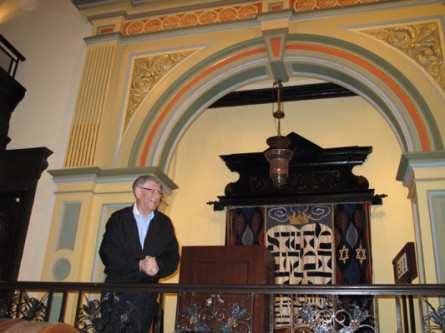
Celebrated every year on the 14th of the Hebrew month of Adar, this year's Purim Festival will be held on 7-8 March. The Society is privileged to organize a special visit on the eve of this celebration, to the Ohel Leah Synagogue, named for the mother of Jacob, Edward and Meyer Sassoon. The three brothers, among the earliest Sephardic merchants from India, donated the land; Jacob Sassoon donated the synagogue, designed by Leigh & Orange in Edwardian free classical style, in 1901.

Our visit to the synagogue will start with a short introduction on the history of the Jews in Hong Kong, followed by a tour of the synagogue and the various parts of this complex. We will taste a kosher dinner that includes a variety of vegetarian dishes in memory of Esther, who is a vegetarian. There will also be some meat dishes of fish, lamb and chicken.

Join us for what promises to be an enjoyable and enlightening evening, learning about the history of a distinguish community in Hong Kong!

Dr. Roslyn Lee Hammers, ‘Beyond Beauty – Regarding the Peony in the Tang to Yuan Dynasties’

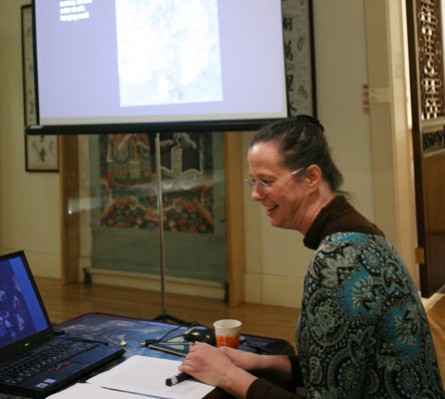
The peony, as a subject worthy of painting and poetry, has an extensive history in Chinese art and literature. As early as the Tang dynasty (618-907), the beauty of the peony incited great appreciation, even mania. In every March during times of peace, Luoyang experienced a carnival of peony extravaganza, as aficionados competed to create, own, and display the most sumptuous beauties. With such sensational attention, the peony became imbued with a wide range of associations. The allure of the flower, long associated with feminine seductiveness, inspired poems extolling its sensuous charms. For most admirers, the peony was celebrated in paintings, praised in poetry, and acclaimed in botanical studies. For others, however, the floral beauty was regarded with some reservations – a subject too seductive for proper scholarly attention or artistic expression. In this lecture, Dr. Roslyn Hammers will explore varying facets of peonies as presented in paintings, poetry and prose, in order to reclaim the complexities it evoked, as well as to consider the apprehension the blossoming temptress motivated.

Speaker
Dr. Roslyn Lee Hammers earned her PhD at the University of Michigan and teaches courses on Chinese painting, South Asian art, and Asian architectural history at the University of Hong Kong. She has published a volume entitled "Pictures of Tilling and Weaving: Art, Labor, and Technology in Song and Yuan China" (Hong Kong University Press, 2011), and other articles on the interactions between technology and artistic production. She was a Fellow at the Needham Research Institute, Cambridge University, U.K. as well as at the Freer and Sackler Galleries in Washington, D.C.

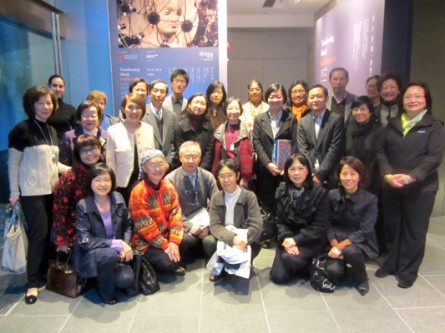
Asia Society Hong Kong Center’s Inaugural Exhibition ‘Transforming Minds – Buddhism in Art’ & Professor Puay-peng Ho ‘Devotion and Patronage: Why and How Buddhist Monasteries Were Built’

We're delighted to present a special tour of the new Asia Society Hong Kong Center's facility and its inaugural exhibition, Transforming Minds – Buddhism in Art, with their Assistant Gallery Manager, Dominique Chan. Following the tour, participants are invited to attend a lecture by Professor PP Ho, Devotion and Patronage: Why and How Buddhist Monasteries Were Built

Asia Society Hong Kong Center's Inaugural Exhibition

Asia Society is establishing a new home at a former explosives magazine/military site in Admiralty on Hong Kong Island, Hong Kong. The site has 4 historic buildings that were developed in several phases between the 1850s and 1920s. Two of the buildings, Magazine A and Magazine B, were used to produce and store explosives and ammunitions. They have now been transformed into a gallery space for exhibitions as well as a small theatre. The Center and an inaugural exhibition titled, Transforming Minds – Buddhism in Art, are set to open in early February 2012. The exhibition will showcase Buddhist works from the world-renowned Mr. and Mrs. John D. Rockefeller 3rd Collection of Asian Arts along with contemporary works by leading Asian and Asian-American artists that draw inspiration from one of the world’s great religions. The show asks the diverse local and international audiences visiting the new Asia Society Hong Kong Center Gallery to consider the ways in which Buddhist art has changed over time and space. Although originating in India, Buddhism travelled across Asia and was transformed by local cultures. Recently, a combination of individualism and an interest in Buddhist beliefs has impacted the artistic production of contemporary artists. This exhibition is a rare occasion to see examples of cultural adaptations and collective responses to Buddhism in pre-modern times as well as individualized responses to Buddhism in contemporary artistic practice. The exhibition will run from the 10 February to 20 May 2012.

Lecture with Professor Puay-peng Ho

Devotion and Patronage: Why and How Buddhist Monasteries Were Built

We appreciate Buddhist sculptures for their beauty in form and serenity in spirit. Obviously, there are more questions that we can ask about the sculptures presented at this exhibition. One may wonder where were they housed originally? How were they commissioned? What were the motives in sponsoring the making of these images? Likewise, similar questions can be asked of the Buddhist monasteries to tease out the social and devotional background of Buddhist establishments. This lecture will focus on China around the 6th-10th centuries to present a broad picture of patronage of monasteries and images at many levels of society, from the emperors to the aristocrats. It will highlight the connection between the form of Buddhist architecture and images, and the purpose of commissioning them. More than 50,000 state-registered monasteries can be found all over China dating to this time period, and the lecture will delineate the intersection between faith, devotion, patronage and the arts.

Professor Puay-peng Ho(何培斌教授) is Director of the School of Architecture and Director of the Centre for Architectural Heritage Research of The Chinese University of Hong Kong. He received his First Class Honours degree in Architecture from the University of Edinburgh and a Ph.D in Art History from the School of Oriental and African Studies, University of London. His thesis focused on Buddhist art and architecture of the Tang dynasty. Professor Ho is a member of the Royal Institute of British Architects and the Society of Architecture Historians. His research interests and publications are in the areas of Chinese art and architectural history, vernacular architecture, and architectural theory.